

Divine and Conquer
Messianic faith does not justify Israel's atrocities

The unfolding devastation in Gaza has precipitated a profound crisis that extends far beyond the immediate geopolitical reality to engulf moral, political, and spiritual dimensions. The intensely contested—and well-supported—claims that Israel is perpetrating a genocide against Palestinians demand our attention not merely as a devastating human tragedy, nor simply as a matter of international law and political conflict. It also expresses a profound internal rupture within the Jewish tradition itself—one that could portend the end of that tradition in any meaningful sense.
Beyond the humanitarian response, what we are witnessing on the ground requires a deeper, existential reckoning with the meaning of Judaism. We are witnessing the fusing of an ancient, diasporic spiritual legacy with the vicious, utilitarian machinery of the modern technocratic nation-state. The sheer scale of the violence—the raw brutality of it—suggests that the political crisis is being fueled by something deeply irrational, by subterranean theological currents (combined with epigenetic trauma and barely concealed ideologies of racial superiority). When these theological energies are stripped of their traditional constraints and unleashed into the realm of political action, they unleash devastation.
Many Jewish friends of mine have gotten caught in this historical undertow, supporting actions they would have found utterly unconscionable just a few years ago—acts of organized savagery they would have decried and protested against in the streets, if these were committed by some foreign totalitarian regime. The revelations of torture, forced drugging, and sexual abuse of over 400 people from 40 countries who participated in the Global Sumud Flotilla, a Gaza-bound aid mission carrying food, baby formula, medical supplies, and other humanitarian goods may turn out to be a breaking point where the international community can no longer tolerate this ongoing assault against human rights and human decency. Public opinion in the United States has turned vehemently against this project of territorial conquest and systemic violence, despite its capture of our political class.
Historian Yuval Noah Harari explored this catastrophic regression in his recent dialogue with Ezra Klein. When asked what he meant by suggesting that the current situation in Israel could destroy or void two thousand years of Jewish thinking and culture, Harari offered a thoughtful reply:
“That historically, and this goes back to the beginning of our conversation, Judaism positioned itself—since the destruction, at least, of the second temple—in opposition to this view of the world as governed only by brute force. When the Roman legions of Vespasian destroy Jerusalem in 70 CE and you have Yohanan ben Zakkai asking Vespasian as a favor, Grant me a small town called Yav[neh], near Tel Aviv of today, where he wants to establish a center of learning. And Vespasian agrees. Okay, you Jews, you can have your center of learning.
And since then, for 2,000 years, Jews in Yav[neh] and then in Cairo, in Baghdad, in Poland, in Brooklyn, they study, they learn. This is again, this was the essence of Judaism. Previously, it was a religion of temples and priests and bloody rituals. And then it became a religion of learning. And if you try to think: What was the most important message of Jews over the last 2,000 years to humanity, I would say that it was the message that it is okay to be different. It is okay to think and behave differently, let’s say, than the majority.
You have, say, a country, I don’t know, like France or Germany. They celebrate Easter and Christmas. They believe in Jesus and so forth. And you have this tiny minority of Jews who say we can think differently. It’s okay. We can behave differently. And this was the essence of being Jewish. And a lot of the thinking and also the practice about what does it mean to have freedom of thought? What does it mean to be a powerless minority was done by Jewish thinkers.
And for 2,000 years, Jews all over the world, they see studying and learning as the highest spiritual activity. And after 2,000 years, you ask them, ‘What have you learned? You have learned, you’ve studied for 2,000 years. What have you learned?’ And then people like Netanyahu tell you, ‘Oh, we’ve learned that you need to be a Roman, that you need to be strong, that you need to build legions, that you need to destroy cities. This is the only thing. This is the only thing that matters in life.’”
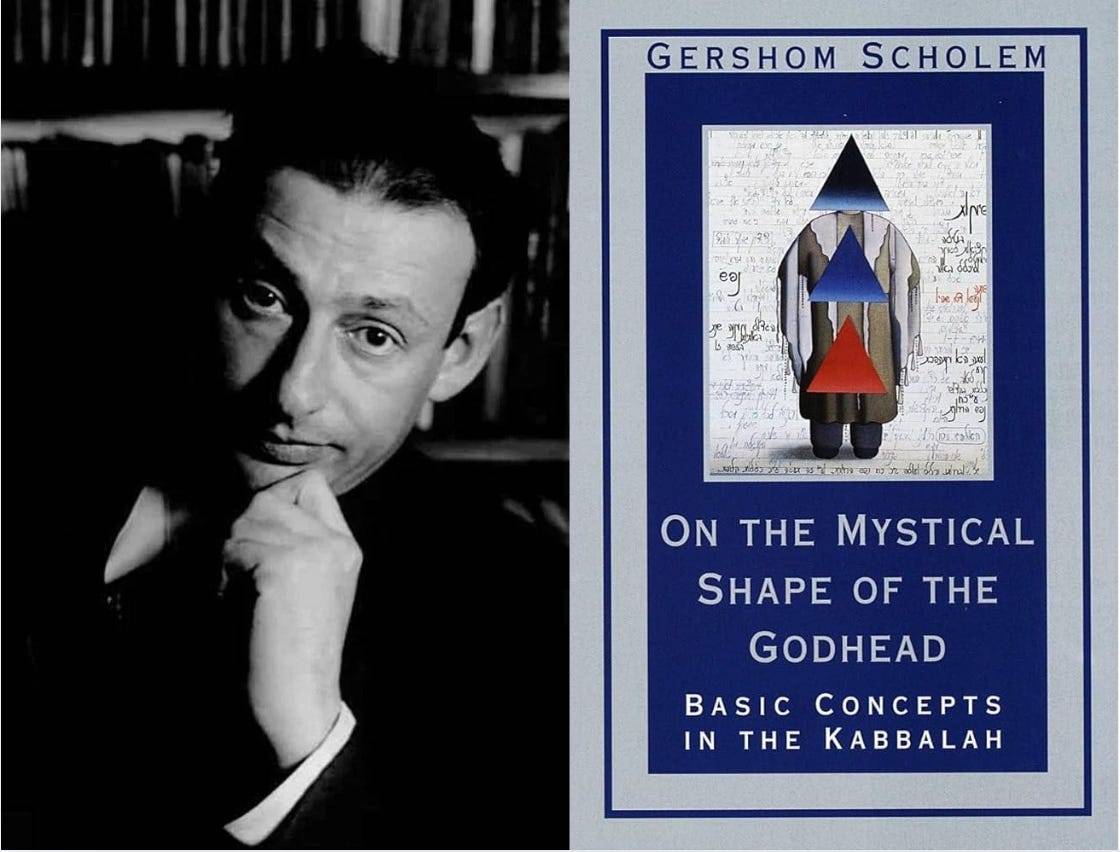
Harari’s observation highlights a stark historical mutation: the transformation of a culture rooted in textual study, ethical and critical thought, ideals of social justice, and the redemptive visions of a powerless minority, back into a cult of state power, military force, and territorial dominance. Yet, this catastrophe of Jewish faith and identity was neither sudden nor unforeseen. Long before the current political leadership embraced the ethos of the Roman Empire, Gershom Scholem (1897-1982)—the preeminent twentieth-century scholar of Jewish mysticism and author of The Messianic Idea in Judaism—warned against the archaic, apocalyptic forces that threatened to tear both the region and the tradition apart.
Scholem devoted his life to mapping the hidden currents of Kabbalah and Jewish mysticism. In works such as Major Trends in Jewish Mysticism, he excavated the intricate esoteric cosmology of Medieval Judaism that orthodox tradition historically attempted to manage and contain. Scholem maintained a lifelong friendship and correspondence with the German Jewish cultural critic Walter Benjamin. In their letters, they continually returned to the intractable problem of historical redemption, approaching the subject from distinct but overlapping angles. Benjamin sought to fuse Jewish messianism with historical materialism, seeking the prospect of “divine intervention” and messianic rupture within the secular mechanics of class struggle. For Benjamin, the revolutionary breaking of the historical continuum carried a necessary theological charge. Scholem, however, focused on the inherent dangers of the theology itself. He saw redemption or the messianic return as events outside of the continuum of history, in any ordinary sense. While Benjamin saw a redemptive possibility in the political sphere of human action, Scholem recognized that forcing the absolute demands of Jewish messianism into any concrete political program—Marxist or Zionist—would lead to failure for the tradition.
Though a devoted Zionist, Scholem harbored deep anxieties about the future of the State of Israel, the secularization of Judaism, and the dangerous intersection of nationalism and religion. He understood that redemption is not a political policy, and forcing it into one is extremely dangerous. One focus of his anxiety was the revival of Hebrew as the official language of the Israeli state. For nearly two millennia, Hebrew was preserved as a sacred tongue—the Leshon HaKodesh—reserved for scripture, prayer, and rabbinic study rather than the mundane activities of daily life. When the modern Zionist movement emerged at the turn of the twentieth century, it resurrected Hebrew as a spoken, secular vernacular to unify a geographically fractured diaspora and forge a cohesive national identity in Palestine. This linguistic resurrection was an unprecedented historical project.
Scholem understood that Hebrew was not a neutral system of communication: it was an inherently mystical script charged with divine revelation and dormant messianic force.
