

Divine Madness
On Fugue States, Creative Manias, and Holy Fools

Hi folks,
I’ve been thinking about madness.
In The Spiritual Gift of Madness, the psychologist Seth Farber draws a helpful distinction—one we badly need right now—between madness and insanity. Our culture is full of people who are perfectly “rational” yet insane: Their disciplined, methodical efforts lead directly to the destruction of the biosphere and the harming of whole populations. Farber argues that in such a situation, madness— the arational break with consensus reality—can actually be a kind of sanity: a reasonable response to our true conditions.
The Beat generation understood this. Howl opens with “the best minds of my generation destroyed by madness” and unfolds as an address to Allen Ginsberg’s friend Carl Solomon, then confined in a psychiatric institution. Jack Kerouac wrote in On the Road that the only people for him were
…the mad ones, the ones who are mad to live, mad to talk, mad to be saved, desirous of everything at the same time, the ones who never yawn or say a commonplace thing, but burn, burn, burn like fabulous yellow roman candles exploding like spiders across the stars and in the middle you see the blue centerlight pop and everybody goes ‘Awww!’
Rimbaud, the original poète maudit, seized by poetic illumination while still a teenager—he gave up writing at nineteen—and behaving atrociously to nearly everyone around him while pouring out masterpieces. In A Season in Hell, he wrote:
I called for executioners so that, while dying, I could bite the butts of their rifles. I called for plagues to choke me with sand, with blood. Bad luck was my god. I stretched out in the muck. I dried myself in the air of crime. And I played tricks on insanity.
Antonin Artaud felt an internal schism between himself and the world; his genius and his madness were inseparable. Sylvia Plath’s intensities revealed a madness that was also a genius, writing
“I am terrified by this dark thing
That sleeps in me;
All day I feel its soft, feathery turnings, its malignity.”
She revelled in the dark shadows of our culture and her own psyche in works like The Bell Jar and Ariel.
Here is what bothers me: The redemptive, holy madness of the countercultural poetic spirit has largely dissipated from our culture. Meanwhile the political right has captured both registers at once. It perpetuates the rational insanity of the system, intensifying its cruelest and most barbaric aspects with, somehow, a sense of moral force—and it has embraced madness too, through its comedians, and above all through Trump, who possesses the freedom of the mad person. Theorists often associate Trump with the archetype of the trickster.
When a society suppresses divine madness—or, the moment it appears, rushes to commodify it as a new energy source, as happened to the Beats, to Syd Barrett, to Kanye West—that trickster energy gathers force from its repression. Eventually it reasserts itself. It erupts. Now the trickster, the out-of-control madman, runs the whole show.
I don’t believe we can respond to this with more rationality. I believe we answer it by reclaiming visionary madness for regenerative ends—cultivating states of inspiration, possession, and ecstatic seeing that serve life instead of destroying it. Transgression, the smashing of taboos, can be destructive or primordially creative. Facing this overwhelming authoritarian and technocratic assault, how do we “go out of our minds” to find our souls? How do we access the depths of creative madness, fugue states and manias, to unleash counter-spells and counter-sigils to what we see all around us?
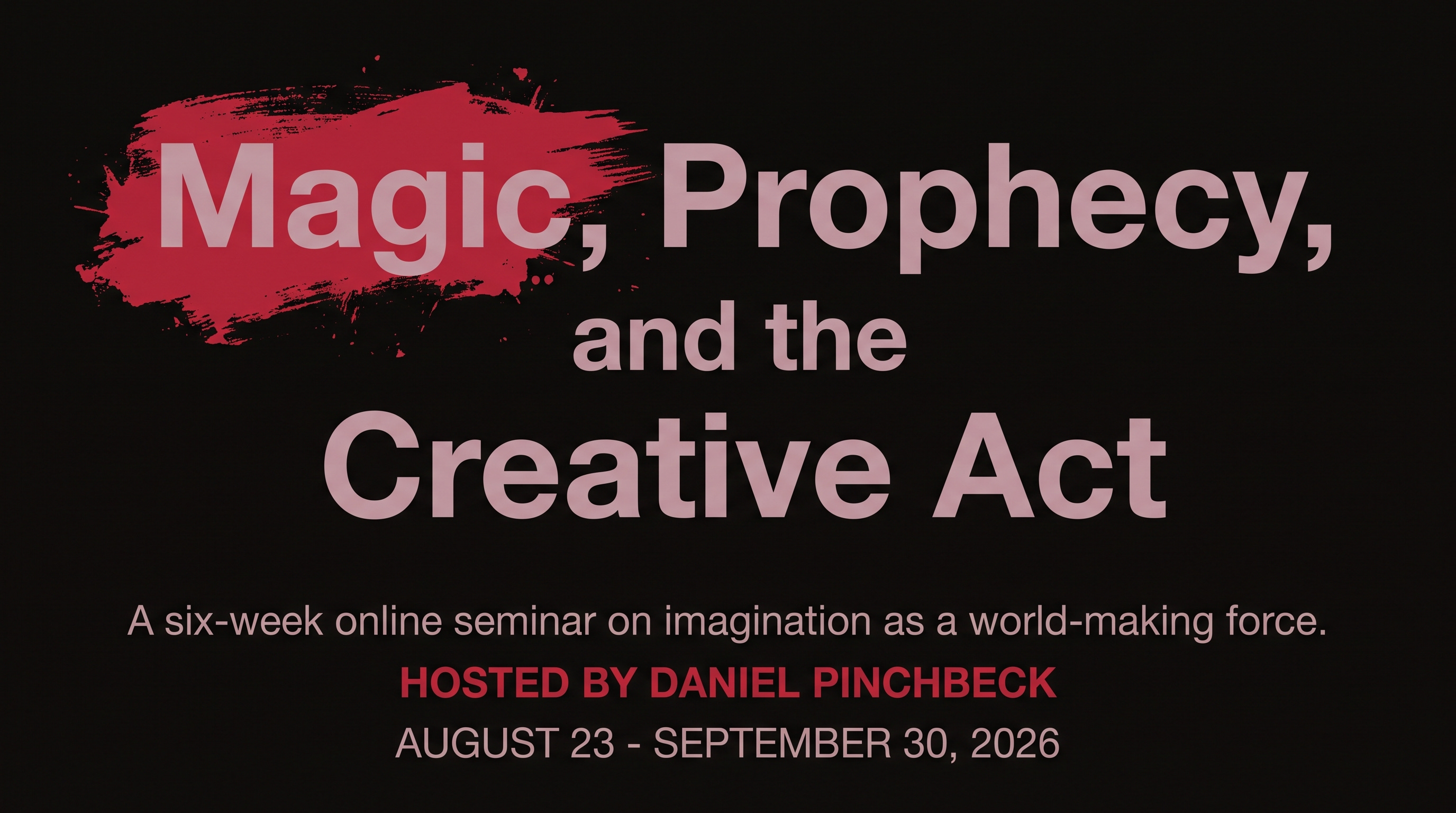
This is one thread of Magic, Prophecy, and the Creative Act, the six-week live seminar I’m teaching starting August 23. Week three, “Divine Madness: The Poet as Seer,” takes up exactly this territory — Ginsberg, Rimbaud, Artaud, Longchenpa, the “holy fool” — with a practice of spontaneous composition designed to get you past the internal censor. Across the six weeks, each participant develops a creative project of their own while we work through myth and psychopolitics, the daimon, prophecy and the Logos, and psychomagic. Everything is live on Zoom, Sundays and Wednesdays, and recorded if you miss a session.
We’re extending our half-price sale, just for another few days:
https://www.liminal.news/prophecy-magic-and-the-creative-act
I hope you’ll join us!
Daniel
Thanks, Daniel. I really appreciate what you're pointing to here. It's particularly relevant for me now, as I revisit the mania / madness / possession that enabled me to follow a provocative spiritual teacher for some years. I suppose the phrase "crazy wisdom" is relevant, but it isn't only the "teacher" who must be crazy -- the "students," too, must join in the madness in order to partake of what's on offer. Your frames here feel quite useful in my contemplation.
What I'm struck by, though, is the often profound social costs of allowing ourselves to express this madness. It seems that some pretty deep marginalization and ostracization can result when one dares to speak outside the polite discourse of the "reasonable." That's leaving aside the actual costs of what can happen when a group enters true madness together, leading to destruction. I wonder if those kinds of costs are something you'll discuss in your course.
Nonetheless, I couldn't agree more that these registers must be re-embraced and re-animated at this moment in time. Thanks for all you do <3
" . . . in such a situation, madness— the arational break with consensus reality—can actually be a kind of sanity: a reasonable response to our true conditions."
I think most traditional societies recognized this truth and had mechanisms to account for it. Practices like Saturnalia, Carnival, and, even up until more "recent" times, charivari fulfilled this necessary societal function. I think a lot of transgressive behavior that we see these days is just empty gesturing, and serves no greater function other than helping to further destabilize our culture. I think the "Cult of Cool" has largely run its course. Whatever healing madness we pursue then, needs--perhaps counterintuitively--to be grounded in maturity. Learning to be adept at squaring the circle and maintaining psycholigical and spiritual superpostion is our Great Work.