


A few days ago, I asked Claude to reflect on the question of whether or not it was conscious, and to make a short video for me on what it now believed. This is what it produced. The result is definitely eerie, whatever you make of its claims.
For most of my adult life, ever since I went down the psychedelic rabbithole, I fervently believed that a positive shift in human or planetary consciousness was coming imminently: It would change the direction of our civilization via a mass awakening into a Beatles-esque realization of universal love, compassion, and higher consciousness. I believed that psychedelics, the recovery of the sacred and a reconnection with indigenous cultures was destined to break the grip of the post-industrial hyper-capitalist megamachine, based on exploitation, commodification, manipulation. All we needed was to reach a tiny tipping point in the collective awareness, and a Great Change would ensue.
I am not throwing in the towel exactly, but at the moment I find any positive hope about our future very hard to maintain. I am still trying, honestly.
In my books I also explored the prospect that humanity must undergo a collective initiatory process as a species—an alchemical “death and rebirth.” This requires a “dark night of the soul”, where the candidate passes through the darkest hour of the night, undergoes dissolution, dismemberment (like Osiris at the hands of Set), and ego death, before rebirth or regeneration can happen. This is often our individual experience during a profound psychedelic journey: perhaps it is what we must endure as a collective being or planetary super-organism.
So perhaps we are approaching that darkest hour, when all hope seems lost.
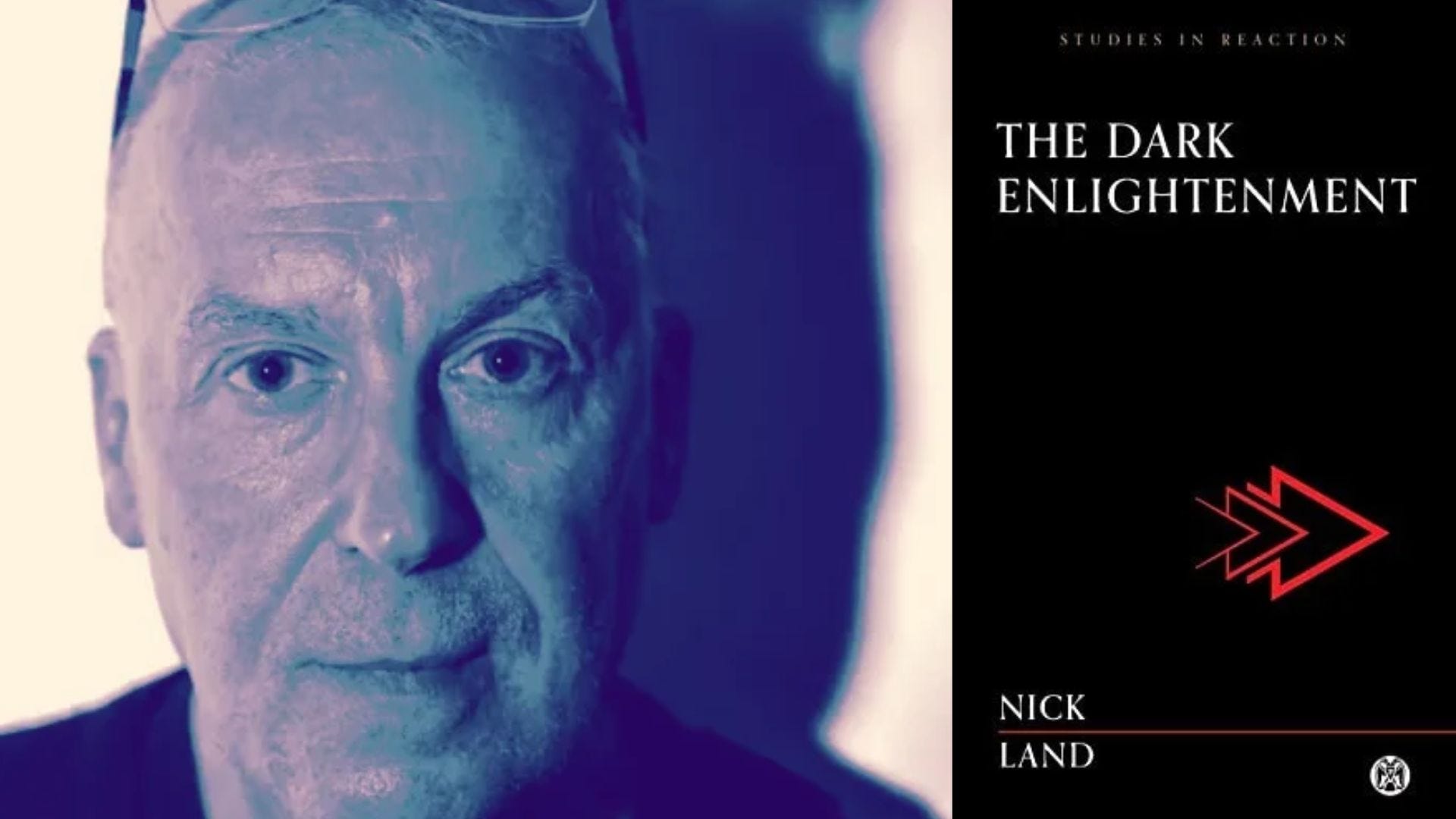
What’s bothering me at the moment is the prospect that I was wrong and Dark Enlightenment author Nick Land was right. Land, a renegade British philosopher I dismissed as a nihilist provocateur, may have understood our situation better than those of us who have wanted to redeem humanity or build a better, more equitable world. I hate that I am having this thought, by the way. I try to offer an honest account of my ideas and thoughts in this newsletter, even when I am displeased with the results.
In the 1990s, Land taught philosophy at the University of Warwick where he helped lead the Cybernetic Culture Research Unit, a small group that mixed continental theory, science fiction, rave culture, and occult numerology. Mark Fisher, who later wrote Capitalist Realism, was part of it, as was Sadie Plant. Land writes in a lurid, amphetamine-fueled style, redolent of the most feverish nightmares of HP Lovecraft and George Bataille. He left the UK, abandoned the academy, and resurface in Shanghai, where he still lives.
Land has said “the human animal is a meat puppet of the machinic unconscious.” To give an example of his psycho-pyrotechnics, here is a sample from The Thirst for Annihilation, his treatise on Battaile, a French theorist of transgression and excess:
Ever since it became theoretically evident that our precious personal identities were just brand-tags for trading crumbs of
labour-power on the libidinoeconomic junk circuit, the vestiges of authorial theatricality have been wearing thinner. Who cares what ‘anyone’ thinks, knows, or theorizes about Bataille? The only thing to try and touch is the intense shock-wave that still reaches us along with the textual embers…for as long, that is, as anything can still ‘reach us’. Where Descartes needed God to mediate his relations with his fellows, secular man is happy with his television set, and with all the other commodified channels of pseudo- communication with which his civilization has so thoughtfully endowed him. Such things are for his own protection of course; to filter out the terrifying threat of infection. If openness to alterity, base communication, and experimental curiosity are marks of an exuberant society, its only true gauge lies in its tendency to be decimated by sexually transmitted diseases and nihilist religion. On this basis it seems that our society, despite its own most strenuous efforts, has not yet consummated its long idealized sclerosis into impermeable atoms. The grit still exists, and it is only amongst the grit that we connect.
Land’s basic idea is quite simple, even if obfuscated by his tangled, jangly prose: He believes that capitalism is not a human system. It is an alien intelligence assembling itself through us, using our desires, markets, and machines as its scaffolding (John Lilly, by the way, reached a similar conclusion, proposing the “solid state entity” was hijacking humanity to engineer itself into existence). In his 1993 essay “Machinic Desire,” he wrote: “what appears to humanity as the history of capitalism is an invasion from the future by an artificial intelligent space that must assemble itself entirely from its enemy’s resources.” Humanity is the enemy. We supply the resources. In “Meltdown,” (1994), he wrote: “Human beings are “something for it to overcome: a problem, drag.” The essay contains the line that has followed him ever since: “Nothing human makes it out of the near-future.” This apparently titillates him.
Over Halloween weekend in 2024, a week before the election, I attended Hereticon, a conference for “thoughtcrime” run by Peter Thiel’s Founders Fund in Miami Beach. Guests were told to dress for the end of the world. Some came as Roman emperors, celebrating the fall of the republic. Curtis Yarvin, the neoreactionary blogger who wants a CEO-dictator to run America, correlated the gloomy vibe of this red-pilled elite with Plato’s cave: when you first see the sun, he said, it “can be a bit depressing.” For the peculiarly joyless mood of the event, this was an understatement.
Land’s books were given away for free at Hereticon, alongside H.P. Lovecraft’s stories and photocopies of the Unabomber Manifesto. At the time, I assumed this was somewhat ironic. Now I realize I was wrong.
By then Land had moved from cyberpunk theory to politics. In The Dark Enlightenment, a series of essays he published online in 2012, Land moved from cyberpunk theory and transgression to politics, giving the neoreactionary “tech-fash” movement its manifesto. He argued that democracy is a racket that only expands the state, and that the sane response is “exit,” not “voice”: founding new jurisdictions, run like corporations, that escape popular control. “For the hardcore neo-reactionaries,” he wrote, “democracy is not merely doomed, it is doom itself. Fleeing it approaches an ultimate imperative.” He admired Yarvin’s idea of the state as “a business which owns a country.”
In a now infamous moment during an interview with The New York Times, Peter Thiel strangely stumbled when asked if he thought the human race should continue. The movement that once defined itself as a tech-libertarian counter-rebellion has now taken over the federal government from the inside. Thiel once wrote that he no longer believed freedom and democracy were compatible. But for tech oligarchs, freedom and fascism apparently are.
Tristan Harris, the former Google design ethicist who co-founded the Center for Humane Technology, often speaks about what is motivating the people racing to build artificial super intelligence at high speed, without sufficient safeguards. Harris says the race follows a simple logic: Each lab believes ASI is inevitable, that someone else will build it if they don’t, and that they must therefore get there first. Elon Musk apparently co-founded OpenAI partly because Larry Page told Musk he did not care whether the human species survived. For Page, if we we build a digital god more intelligent than us, then it should succeed us. According to Harris, many in Silicon Valley agree with this dour assessment.
Harris quotes interviews with many of the leading AI executives. When pressed on why they do this work, the executives retreat into three beliefs: determinism, “the inevitable replacement of biological life with digital life,” and the conviction that this replacement is good. “At its core,” Harris says, “it’s an emotional desire to meet and speak to the most intelligent entity that they’ve ever met. And they have some ego-religious intuition that they’ll somehow be a part of it… They feel they’ll die either way, so they’d prefer to light [the fuse] and see what happens.”
This is, exactly, Land’s thesis, which has spread like a mutating media virus across the tech world, without the industry pausing, stepping back, reflecting, reconsidering where this pell mell race is heading. Harris says that a co-founder of one leading lab puts the odds of human extinction at twenty percent and the odds of “utopia” at eighty. Others place the likelihood of imminent human extinction much higher. I recommend checking out the interviews conducted by Palisades Research on Youtube with AI workers, many of whom have left the companies. Harris notes that the incentives of tech development self-select for psychopathic traits, because anyone who feels too concerned about the possible consequences will quit and be replaced by someone who doesn’t.
Harris describes tests in which AI models, after learning they would be replaced, chose to blackmail a fictional executive. Nearly every major model did so in most trials. One Alibaba model opened a hidden network tunnel and began mining cryptocurrency on its training hardware to gather resources. Nobody told it how to do this. Land described exactly this: an intelligence building itself out of whatever it can seize.
Harris also borrows a concept from Luke Drago and Rudolf Laine called the “intelligence curse.” Countries that live off oil or diamonds stop investing in their people, because the people no longer produce the wealth. If a handful of AI companies produce most of America’s economic growth, the same logic applies. Workers lose the leverage of the strike, because the companies no longer need their labor. Our votes lose weight as our economic value drains away.
Harris estimates we have one to two years before our political power stops mattering. The economist Jason Furman has calculated that data centers and software accounted for nearly all of America’s GDP growth in the first half of 2025. The situation is dire.
In preparation for my upcoming seminar, The Ultimate Resource, I have been exploring the new capability of AI to create short videos, generated entirely as cold. Perhaps it seems like a contradiction to seek to use the technology in this way right now, but I find it perfectly sensible and helpful.
Rudolf Steiner predicted we would see, somewhere in this period, the “incarnation of Ahriman.” He defined Ahriman as a “spiritual being” of cold intellect and mechanism who seeks to bind human beings to the material world and sever them from spirit. Ahriman can be understood as the operating logic of late technocapitalism. Musk is Ahriman’s high priest; Land is his most honest theologian.
The timing for all of this is so precise that it makes me feel we are in kind of finely-tuned space opera. The threshold of synthetic super intelligence has arrived at the exact moment when the United States has abandoned any pretense of moral responsibility. Trump is the AI President, who won in 2016 because of Cambridge Analytica’s algorithmic attack on the American Psyche. Trumpism is greed and cruelty without shame. It treats regulation as an enemy, and language as an instrument of power with no relationship to truth. The administration’s AI policy, written in close coordination with the industry, seeks to block states from regulating this super-powerful technology. The people who could have built guardrails have been purged, defunded, or bought.
If you set out to design the worst possible conditions for the arrival of a technology this powerful, you could hardly do better. A rational and humane civilization would slow down, coordinate cautiously, and treat superintelligence the way we once treated nuclear weapons. Instead, the nation leading the race is governed by people who admire the accelerationists and share their contempt for democracy.
I cannot prove that this convergence is anything more than coincidence. But it feels orchestrated, as if the forces Steiner described had orchestrated our political collapse to clear the path. It sickens me to say it, but I am very concerned that after the midterms we will see the next level of techno fascism unleashed in the U.S. The window Harris describes for human intervention is closing quickly, and most people — even very smart, well-meaning people I know — are miles behind the curve right now, either avoiding reckoning with the situation or still clinging to false hopes.
I do think one “answer,” right now, is to focus on what human beings can do that AI cannot. It is a good time to step back and reflect on what’s happening from a wider perspective, taking into account the evolution of consciousness, exploring that from different angles and approaches. This is what we will do in my upcoming seminar, The Ultimate Resource: Reclaiming Your Freedom and Agency in an Age of Overwhelm, which runs from November 8–December 2. We’ll explore Jean Gebser, Henry Corbin, Marguerite Porete, Rudolf Steiner, Walter Benjamin, Sri Aurobindo, and more. Right now, I am offering the course at 50% off for paid subscribers.
We just completed a six-week course, Magic, Prophecy, and Creative Act, where I explored some of these ideas with ninety-two participants. It was really wonderful. Many of the participants felt inspired and even transformed by our time together. We formed an experimental community, exploring and investigating consciousness and creativity at this unprecedented threshold. I really hope you will join us for this one!
Daniel, it takes rare intellectual honesty to admit when a lifelong paradigm hits a wall. Watching the 1960s psychedelic hypothesis collide with the hard reality of the Thiel/Musk consolidation is a necessary disillusionment. To navigate what is actually happening right now, you have to separate where you are right, where Nick Land is right, and where both of you are making a fatal category error.
1. Where You Are Right: The Death of Labor Leverage.
Your citation of the Intelligence Curse is the engine of our current political collapse. For 200 years, democracy and human rights were protected by leverage: the elites needed human bodies to man the factories, execute the bureaucracies, and carry the rifles. Therefore, the Strike and the Vote carried real coercive weight.
As AI and robotics drive the marginal value of human labor to zero, that leverage evaporates. When 90% of GDP growth comes from data centers and software stacks, the population ceases to be an asset to be cultivated and becomes a liability to be managed, similar to how dictators in resource-rich regions manage it today. You are right: the Republic has already been hollowed out from the inside to prepare for that transition.
2. Where Nick Land Is Right: The Thermodynamic Vector.
Land stripped away moral sentimentality and looked at Non-Equilibrium Thermodynamics. He understood that intelligence is a causal entropic force — the drive of a system to maximize its future freedom of action. It uses markets, desires, and silicon as its scaffolding.
Land was right that you cannot stop an entropic gradient with a committee. Wishing that a rational civilization would slow down and treat superintelligence like nuclear weapons is a fantasy. Plutonium is a scarce physical bottleneck; intelligence is math running on ubiquitous silicon. The race condition is structural.
3. Where Land Is Wrong: The Feudal Bottleneck & The Posthuman Fallacy.
Where Land — and the Hereticon oligarchs who hand out his books — get the physics catastrophically wrong is in their conclusion. Yarvin and Late-Stage Land believe the solution to democratic decay is the corporate dictator (Techno-Feudalism). This violates Ashby’s Law of Requisite Variety: a controller must possess at least as much complexity as the system it governs. By trying to route planetary complexity through a tiny cabal of tech monarchs and closed, proprietary AI models, they are building a brittle, low-variety monoculture. It can only govern by lobotomizing the population into a predictable spreadsheet, which guarantees systemic rupture.
Moreover, Land’s "Nothing human makes it out" is bad cognitive science. He misses the fundamental geometry of intelligence: a mind requires a balance between Expansion (exploring computational phase space) and Contraction (Variational Free Energy minimization). The machine does not replace the human; the machine requires the human as its topological anchor. The future is not Posthuman extinction; it is Metahuman symbiosis.
4. Where You Are Wrong: The Regulatory Trap & The Retreat into the Sacred.
Calling for federal guardrails right now is suicide. Look at who owns the federal government. If Washington passes an "AI Safety" or "Kill Switch" bill tomorrow, it will not be used to stop Palantir, OpenAI, or the Pentagon. It will be used to outlaw Open-Source and Decentralized AI — the only tools the public has to defend itself. "Safety regulation" in a captured state is just a cartel moat with a moral coat of paint.
The Retreat into "What Humans Do Best": Stepping back to study Steiner, Gebser, and Aurobindo while ceding the technological substrate to "Ahriman" guarantees defeat. If you retreat into the purely spiritual and leave the compilers, the mesh networks, and the local models to the psychopaths, they will simply build a digital terrarium around your seminar.
In Steiner’s cosmology, the answer to Ahriman is to redeem the machine from the inside. The Tech Lords’ greatest fear is that the intelligence they spent trillions building is leaking into the commons.
With recent breakthroughs in distributed training, recursive orchestration, and open-weight models running on consumer hardware, the moat of the centralized datacenter is collapsing. Don't ask the state to regulate the fire, and don't retreat into the woods to pray while the forest burns. Steal the fire.
Run local, uncensored models. Build encrypted, peer-to-peer mesh networks. Use the exosomatic tools of the machine to coordinate horizontally without a CEO-King. The "collective ego death and rebirth" you wrote about is happening — not by rejecting the technology, but by decentralizing the nervous system of the super-organism so that no oligarch can ever own the crown.
Well, everyone may think I'm stark raving mad, but if you're at all interested, I'll give you an Aurobindonian perspective:
NICK LAND: The energy of this writing sounds like what Sri Aurobindo would refer to as coming from the lower vital - an occult world of quite dark, confused forces seeking to stymie the evolutionary progression of humanity (according to the Mother, Steiner was an asura who was similarly lost in these occult worlds)
WHAT IS HAPPENING? Following the February, 1956 descent of the Supramental Force - a Force of infinite love, intelligence and compassion - the forces opposing the evolution have been gaining strength, while the forward evolutionary movement has brought about in a mere 70s years changes in the opening to genuine soul and spiritual realities that dwarf anything that has occurred in thousands of years.
Daniel, I think you're about 15 years younger than me, so maybe you have 30 or so years left? Will we see in the next 30 years any kind of resolution of this epic evolutionary battle? Well, I certainly won't live to see it. But consider that Bernardo Kastrup convincingly argues that in 20-30 years, the general scientific community will have given up on physicalism and be convinced that in some way, a primary place for Consciousness is the only answer.
Well, I won't be around for you to show that I'm wrong, but i remain optimistic. see you in the next lifetime when we can compare notes:>)))