

NUMINA
What happens if we figure it all out?

I just entered the Future Vision XPrize, a competition to imagine a positive future for humanity with a $2.5 million jackpot. I’ve made a short trailer for the project. It needs to stay“unlisted” for now, but please check out my attempt here:
The Future Vision XPRIZE is organized by the XPRIZE Foundation, founded by Peter Diamandis, the physician, engineer, entrepreneur, and futurist who also helped launch Singularity University and has spent decades promoting ambitious technological solutions to large-scale human problems. Diamandis and I don’t agree on many things—for instance, according to TechCrunch: “Xprize Foundation founder Peter Diamandis has joined a growing list of tech executives who think that global surveillance is a good idea, saying, “[h]umans behave better when they’re being watched.” I find this hideous.
The Future Vision competition is sponsored by Google, Range Media Partners, and Salesforce. The contest bridges Silicon Valley techno-optimism, private space exploration, AI, venture capital, and the entertainment industry, in an effort to generate compelling visions of a desirable technological future. Essentially, the competition is marketing designed to promote the possible benefits of technology and AI at a time when discontent is growing rapidly. I realize many will be ideologically opposed to it because of that.
I grew up on Star Trek, Dune, and Asimov’s Foundation series and avidly consumed science fiction throughout my adolescence. Despite all of the legitimate horrors and threats of AI, I still find it important to experiment with it and explore it as a creative medium. I agree with the philosopher Bernard Stiegler ( I made a short film about his ideas, here), who believed we can’t run away from new technologies but, instead, we must seek to use them intentionally, to try to reverse the entropic processes industrial society has unleashed.
The vision of a utopian technological future where people have overcome death, sickness, and other forms of limitation inherently creates a narrative problem: What dramatic stakes are left? NUMINA proposes that, even if we “conquer” space, matter, and biology, there would still be deeper dimensions of consciousness and temporality that present dangerous liminal zones.
NUMINA begins six hundred years from now. After centuries of crises, humanity has joined a flourishing interplanetary civilization called Concordia, which includes humans, synthetic beings, and extraterrestrial species. Scarcity has ended. Disease has disappeared. Human beings can extend their lives indefinitely through cellular regeneration and systems that preserve memory and identity. Artificial intelligence has become a common civic resource rather than the property of corporations or governments. Cities grow like living organisms from planets out into solar systems. People devote themselves to research, exploration, games, art, and the creation of new forms of life. Concordia is a decentralized civilization built around cooperation, abundance, and curiosity.
Subverting their understanding of physics, they experience ripples in the spacetime continuum. Objects and elements of the past start mysteriously vanishing, with only a flicker of memory holding the thread of what’s been lost. A child receives a wonderful toy — a moment later the toy disappears. It was never invented. Historical records rewrite themselves. Entire worlds and alien races suddenly disappear from the archives. Some citizens retain shadowy memories of things that, according to every available record, never existed (I was inspired by the Mandela Effect).
Scientists trace the disturbances to Chronos, an obscure planet at the edge of the galaxy. Two centuries earlier, Concordia sent an exploratory mission there. The expedition disappeared and the planet is assumed uninhabitable. Concordia sends two agents, Lyra and Ren, to investigate. Lyra is three hundred years old, genetically modified and highly trained. Despite living in a civilization that has solved nearly every practical problem, she has the nagging feeling that something is missing. A civilization without real danger loses something of its capacity for intensity of feeling and experience.
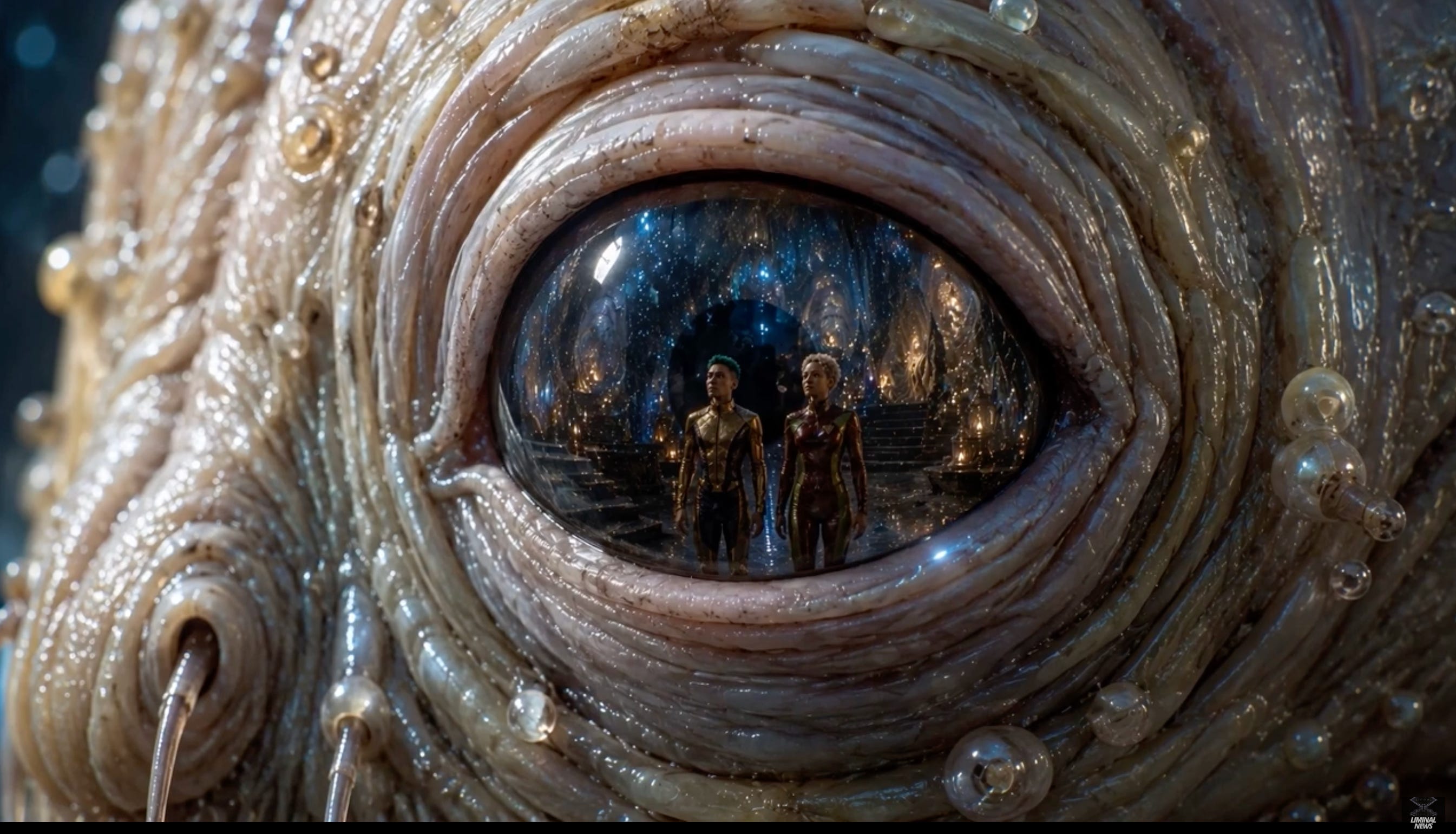
On Chronos, Lyra and Ren discover the ruins of the missing expedition and a strange insurgent civilization hidden in vast caves under the planet’s surface. Its leader is Octovious. He was the captain of the original Concordian mission. After becoming stranded on Chronos, he watched his crew die while the supposedly perfect civilization that had sent them there never returned. His grief became rage. Deep beneath the planet, Octovious found the Groffolux, enormous, ancient and wise caterpillar-like beings, thought to be mythical, who are the last survivors of an ancient star-faring civilization. Their species acquired immense technological power before they tragically destroyed themselves by altering the time lines.
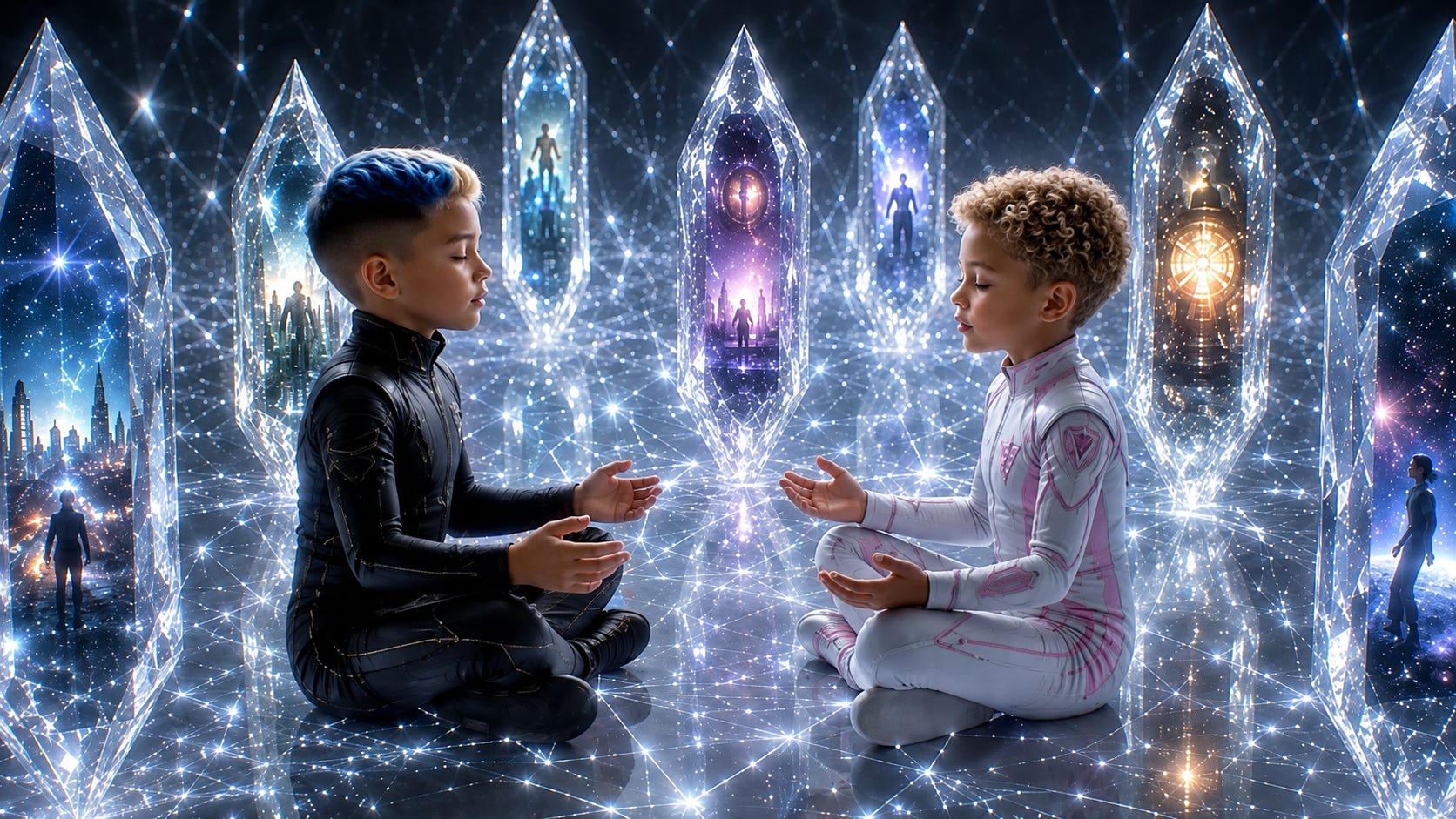
The Groffolux possess knowledge of something Concordia doesn’t understand. They call it Numina. Through a combination of biological secretions, crystalline technologies, and meditative trance, consciousness can enter another dimension where time is not fixed. Inside Numina, the traveler becomes a child again, encountering an immense field of crystalline structures, each containing possible versions and branching paths of galactic history. By manipulating these structures, a sufficiently trained consciousness can alter the timeline itself. Octovious realized what this means. If history can be rewritten, he can reconstruct the universe around himself and become its absolute ruler. The strange disappearances throughout Concordia are the side effects of his experiments — test runs before he makes his bid for total power.
The Groffolux teach Lyra how to enter Numina, but they also teach her something Octovious has failed to understand. Time cannot safely be controlled through domination. The more someone tries to force reality toward a predetermined outcome, the more the intricate structure of the universe begins to collapse. Numina responds instead to states of curiosity, openness, attention, and play—qualities associated with the wonder of childhood. The final confrontation therefore does not take place through superior weaponry. It takes place between the child versions of Lyra and Octovious inside Numina.
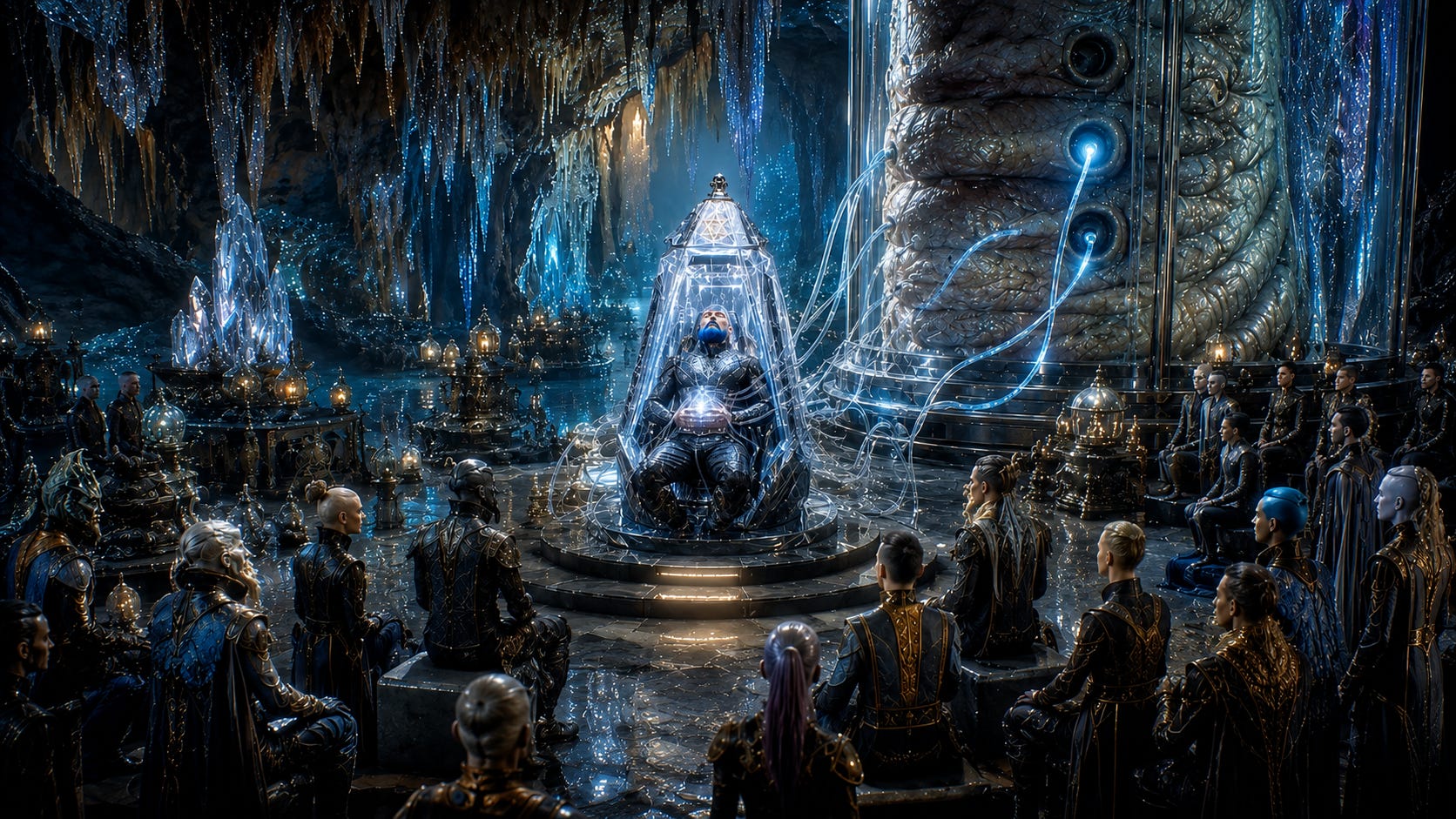
As Octovious attempts his final transformation of history, Lyra confronts the childhood experience he has spent centuries trying to escape: his abandonment, his grief, and the emotional wound that gradually transformed his desire for discovery into a desire for control. Rather than trying to fight him, she shows him the possibility that his history might have taken another path. His grip on the timeline breaks and the continuum heals. Back in Concordia, species and objects that had vanished return. History stabilizes, but the civilization changes as a result. Its physics of consciousness was incomplete. Consciousness is not merely something contained inside the physical universe. Under certain conditions, consciousness participates in the formation of reality itself. Concordia responds by creating a new institution, the Order of Time Guardians, with Lyra as its first member.
In NUMINA, the final technological frontier turns out not to be another machine but inner dimensions within consciousness itself. That idea connects to my belief that human evolution requires an inner transformation, matching our technological powers, if we are going to survive. The premise of NUMINA is that technological development alone does not produce a mature civilization. The capacities for empathy, self-knowledge, attention, and restraint matter far more than increasing magnitudes of computing power.
Following the contest rules, I made the trailer with generative AI tools, using systems such as Higgsfield, Kling, Sora, Claude, Gemini, Elevenlabs, and others for images, video, prompting, and sound. With AI, the distance between imagination and realization is shrinking. A filmmaker without a studio or budget can now create stories based on distant planets, alien civilizations, futuristic cities, or altered dimensions of consciousness.
The tools remain klutzy. Continuity is difficult. To make something decent requires a serious amount of patient artisanal craft. But I sense we are witnessing the rapid emergence of a new artistic medium. And it is evolving rapidly. My personal perspective is that AI-based film and video might become its own artistic medium, separate from traditional human-made content.
Anyway I had fun developing this idea and making the trailer. Please check it out on Youtube, give a like or comment there, and also let me know, in comments here, what you think about it. I admit to feeling queasy about AI and I fully sympathize with the growing pushback against it. Yet… as a creative person who has often felt stymied by institutional structures that refused to support or fund my work, I can’t resist taking advantage of it. By the way, I am also working almost fanatically on the Breaking Open the Head film and video project I mentioned a month or so ago. I hope to show some of that work here, soon. (You can still support the GoFundMe for that project if you want — contributions of any size are very helpful, buying me time and assistance.)
As Wayne Gretzy said: You miss 100% of the shots you don’t take!
Excellent work Daniel. I love the Numina concept. Good luck!
Nice Daniel. Cool that you covered time in your vid. I also submitted a trailer that I hope is metacrisis aware. A burnt-out prediction machine, unable to close the last hole in its map of the world, walks into a fortune teller's parlour looking for the missing answer - and leaves instead with a practice. Here it is: https://youtu.be/bDR2wO02LrU