

Oh, Lucky Man!
Who is Howard Lutnick? What is his role in the structural transformation of the U.S. financial system?

I have become repulsively fascinated by Howard Lutnick, the billionaire Chairman of Cantor Fitzgerald, a Wall Street firm, and Trump’s Secretary of Commerce. I knew nothing about him previously. As I go down the Lutnick rabbit hole, I am learning some fascinating tidbits, which I am excited to share over a multi-part series. I realize there are many details and some digressions in what follows. I hope you will take the time to work through it with me.
This first part of this series delves into Lutnick’s background. The truly interesting and most relevant—to our future lives—information will be reserved for later sections. But it is all important information for us now.
Let me preview where this is going. Essentially, Lutnick turns out to be a major player in a massive transition the Trump regime and his allies in crypto currently seek to engineer in both the U.S. and global financial system. If I understand it properly, the shift involves using crypto—particularly the stablecoin, Tether (UST), which The Economist calls the “money launderer’s dream currency”—as a mechanism to deal with the structural problem of US Treasury debt, which few countries want to buy anymore, while further centralizing power and control in the hands of the billionaire “Epstein class.”
As I have explored in previous essays, one goal of the Trump administration is to decimate the middle class in the U.S. This is what Trump’s tariffs are meant to accomplish, as they force smaller businesses to shut down due to the impossibility of making long-range plans or managing imports. A strong and well-resourced middle class provides a dangerous opposition to authoritarian or Fascist centralization of power and control. Hence every dictator seeks to break the middle class and increase social inequality.
As we will explore, Lutnick helped draft the GENIUS Act, a federal piece of legislation on cryptocurrencies, passed by Congress and signed into law by President Trump on July 18, 2025. “GENIUS” stands for “Guiding and Establishing National Innovation for U.S. Stablecoins.” The Act requires stablecoins to be backed 1:1 by U.S. Treasuries. Critics argue this act creates a “backdoor Central Bank Digital Currency (CBDC)” because it forces crypto liquidity into government debt. The GENIUS Act also ensures that Lutnick’s family firm, Cantor Fitzgerald, collects ongoing massive fees for managing those reserves because of its legal position as the custodian of Tether, a stablecoin which is now structurally integrated into the U.S. financial system.
The U.S. government is running massive deficits (nearly 6% of GDP) and needs buyers for its debt. Stablecoins are mandated by the GENIUS Act to hold short-term Treasuries as reserves. Every new Tether “coin” or USDT minted requires more purchases of US Treasury bills. This has a cascade of effects, many of them hard to fully understand. As The ABA Banking Journal explores in “How stablecoins could affect borrowing costs for the government, businesses and households”, one impact will be reduced credit available for “Main Street” (tangible, real-world businesses) since dollars flowing into stable coins (primarily Tether) leave the traditional banking system.
The main stablecoin being employed by the Federal Government as a tool for dealing temporarily with the US deficit is Tether, launched by Tether Limited Inc., a financial services company co-founded by former Mighty Ducks star and former Bitcoin Foundation Chairman Brock Pierce in 2014. Pierce is a key player in this evolving story, as we will see. While Tether now has a structural role in the U.S. financial system, many questions remain about it. It has never passed an audit.
Lutnick’s firm, Cantor Fitzgerald, is the primary custodian of Tether’s assets, as well as owning a 5% stake in Tether itself. Tether Limited Inc is an offshore company registered in the British Virgin Islands; it can’t enter Treasury auction to buy government debt directly. Tether needs a licensed U.S. financial institution to serve as its broker and custodian—to actually purchase the Treasuries, hold them in regulated accounts, and manage the portfolio. That’s what Lutnick’s firm, Cantor Fitzgerald, now does.
Learning about Lutnick’s checkered past will help us understand the likely result of his family firm’s position as a bridge between US Treasury bonds and the cryptocurrency world. Cryptocurrency investors were the largest financial supporters of Trump’s 2024 Presidential campaign. Trump received over $22 million from at least 17 major crypto industry donors, with $8.3 million of that donated directly in cryptocurrency like bitcoin, ether, and XRP., according to Fox Business. Trump’s PAC, the Trump 47 Committee, raised about $7.5 million in crypto tokens.
Interestingly, the latest release of the Epstein files reveals Epstein as a key player in the back story of Bitcoin and Tether. Epstein was brought into the crypto world by Pierce, who worked closely with Steve Bannon for many years on his earlier company, Internet Gaming Entertainment (IGE), founded in 2001. IGE sold in-game gold, weapons, and items “mined” from MMORPGs like World of Warcraft and EverQuest for real money. It used “gold-farming” operations in China, with low-wage shift workers accumulating in-game currency and virtual goods to sell to American gamers. Pierce brought in Bannon to seek venture capital, securing a $60 million deal in 2006. Bannon became vice chairman of the company. Pierce described Bannon as “my right-hand man for, like, seven years.” Pierce later introduced Jeffery Epstein to Bannon , and the two became close friends.
We’re now seeing a coordinated effort to integrate cryptocurrency into the traditional financial system and government surveillance apparatus. I don’t agree with the Libertarian naiveté of Aaran Day, a journalist who still believes Bitcoin was intended to be a real currency that could be used for daily transactions. But other parts of Day’s research are fascinating. He argues that Lutnick, Pierce, and Epstein played crucial roles in channeling the liquidity of the crypto market into U.S. government debt via Tether and the Genius Act, capturing the revolutionary potential of decentralized finance within the institutions it was designed to bypass:
Okay, so let’s learn something about Howard Lutnick.
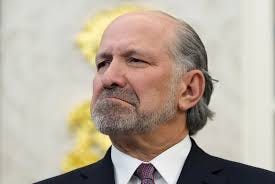
Lutnick has been making headlines recently because of the bizarre, blatant, over-the-top lies he keeps making about his long, close relationship with Jeffrey Epstein. He lied to a NY Post reporter and he lied under oath during a Senate hearing when he said: “I did not have any relationship with him. I barely had anything to do with that person.” On Miranda Devine’s podcast last October, Lutnick said he would never be in the same room with Epstein after an initial meeting in 2005 at his mansion, which just happened to be next door to Epstein’s. Both houses were previously owned by Les Wexner, former CEO of Victoria’s Secret, who was Epstein’s benefactor.
“This guy was the greatest blackmailer ever,” Lutnick said about Epstein. “That’s how he had money.” Lutnick is prone to bouts of raucous laughter whenever Trump brings up Epstein.
Lutnick, himself, is no slouch when it comes to running a racket. Last week, we learned that Lutnick’s family firm, Cantor Fitzgerald, made very profitable bets against Trump’s tariffs — potentially collecting a few hundred million dollars when the Supreme Court rejected them. This is quite astonishing when we consider that Lutnick was the point man selling Trump’s tariffs across every major television network.
In numerous appearances, over and over again on Fox News, Lutnick expressed confidence that the Supreme Court was going to validate Trump’s use of emergency powers to implement broad “reciprocal tariffs.” On Hannity in November 2025, Lutnick called the legal battle, the “Superbowl of Trade”. He argued that the justices would recognize the necessity of these powers for national security and geopolitical stability, stating:
I think the justices know it—they know the law. They went over the words... if you listen to the second half [of the arguments] today, you left like I did, very confident that the President of the United States, Donald Trump, is going to win this case because these powers protect America.
Lutnick called the tariffs a critical tool for “stopping the ripoff” of the United States and protecting domestic industries like steel and aluminum. He emphasized that the President was using these authorities as leverage to end foreign conflicts (haha!) and address the fentanyl crisis, suggesting the court would not strip the executive branch of such helpful instruments.
At the same time, according to Wired and MS NOW, a Cantor subsidiary run by Lutnick’s sons engaged in a lucrative “litigation finance” trade, purchasing the rights to federal tariff refunds from companies at a steep discount of roughly 20 to 30 cents on the dollar. When the Supreme Court eventually struck down the tariffs in February 2026, these rights surged to their full value, potentially netting the firm a windfall of hundreds of millions of dollars—a trade that MS NOW called “betting against the house” while serving in the cabinet. As Wired noted in its detailed exposé, internal emails confirmed the firm had the “capacity to trade up to several hundred million” of these rights.
Congressman Jamie Raskin has demanded an investigation into whether the Lutnick family utilized “nonpublic insight” to position themselves for a massive payout due to privileged information.
If that is how Lutnick operates now, what has he done in the past? According to a 2024 Forbes profile, Lutnick earned the moniker, “the most hated man on Wall Street.” I can only imagine there must be steep competition for that honor!
One of his former employees told Forbes: “He only cares about himself. Trump is president for his own personal gain. Howard Lutnick runs his business in the same way. These guys are peas in a pod.” Forbes noted that few were willing to share their thoughts on the record: “People are very scared of him,” says a former colleague. “I witnessed this stuff first-hand. I witnessed the bullying. I witnessed the aggression.”
Bernard Cantor hired Lutnick in 1983, soon after he graduated Haverford. By the time he was 30, Lutnick was president and CEO—a rapid ascent. Cantor Fitzgerald’s business was buying and selling US Treasury bonds at high volume and high speed. By the early 1990s, Cantor was so good at these trades that they handled about a quarter of that entire market. As CEO, Lutnick moved Cantor Fitzgerald into other areas such as bonds, derivatives, swaps, and futures. Revenues tripled from 1991 to almost $600 million in 1996. He also launched an electronic brokerage platform, eSpeed, to accelerate the speed of transactions.
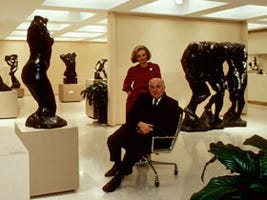
When Bernard Cantor became ill in the 1990s, Lutnick repaid his mentor by forcing him out and stealing the firm from his wife. Forbes writes:
In 1995, with his mentor’s health in decline, Lutnick teamed up with two other partners to try to buy out the Cantor family. The deal never happened, so in January 1996, Lutnick activated an incapacity clause that had been outlined in the partnership agreements. That five-member group voted to strip Cantor of control of the firm he founded…
Iris Cantor, Bernie’s wife and a former stockbroker, tried to assert control over the firm. She lost to Lutnick. When Bernie died in 1996, Iris barred Lutnick from attending the funeral.
We don’t know when Lutnick met Epstein, but it was probably in the late 1990s. Epstein was involved in managing Lutnick’s house at 11 East 71st Street, which was next to his own home—the lavish mansion that Victoria’s Secret CEO Les Wexner, for reasons still unknown, gave to Epstein, along with legal control of his enormous fortune. An entity linked to Wexner also bought Lutnick’s future home in 1988. The mansion passed through Wexner-related trusts where Epstein was a trustee, until Lutnick bought it for $7.5 million in 1998.
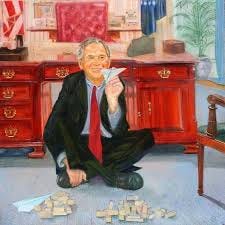
It might even be the case that the two were close friends (as much as men like them have “friends”). The records for Epstein’s emails from 1999 - 2002 are, suspiciously, missing from the Epstein Files, fueling conspiracy theories around Epstein’s role in 9/11 and the Iraq War. Epstein featured this odd portrait of George Bush in his New York townhouse:
On September 11, 2001, Lutnick entered the public consciousness in a big way. His firm, located high up in the World Trade Centers, lost almost 700 people due to the terrorist attack. While Lutnick’s brother and many close associates died, Lutnick himself luckily happened to be out that morning.
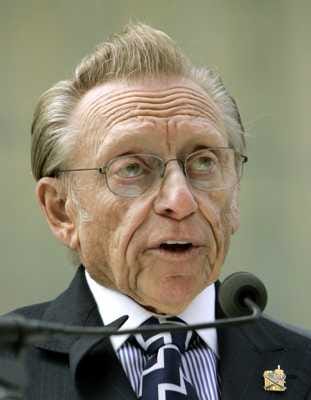
Interestingly, a few other lucky soon-to-be billionaires just happened to be absent from their offices high up in the WTC that morning, despite their regular routine. The leaseholder of the building, Larry Silverstein, was apparently known for his habit of arriving at his office in the Twin Towers each morning and eating breakfast at Windows of the World. That morning, he went, instead, to a dermatology appointment. Silverstein’s kids also luckily shifted their routines to miss a date with destiny, according to reports: “Two of Silverstein’s children, his son, Roger, and daughter, Lisa, would regularly attend meetings with important clients at Windows on the World. That morning, they too were running late and were not at Windows when the planes hit.” Silverstein later received $4.55 billion in insurance settlements for the destroyed WTC. He leased the towers only a few weeks before 9/11, in July 2001, making a personal investment of $14 million. For that $14 million investment, post-9/11, Silverstein received the rights to rebuild a $30 billion complex, garnering tremendous wealth.
The story Lutnick has told—repeatedly, on camera—is that he was dropping his son off for his “first day of kindergarten:” An extremely rare late start for him. Early accounts placed Lutnick at the Park Avenue Synagogue on the Upper East Side. Later versions specified the Horace Mann School. But most New York City schools opened the week before, on September 5 and 6.
