

Silver Lining in the Black Clouds?
Could the demolition of our institutions and economy lead to a new vision for humanity's future?

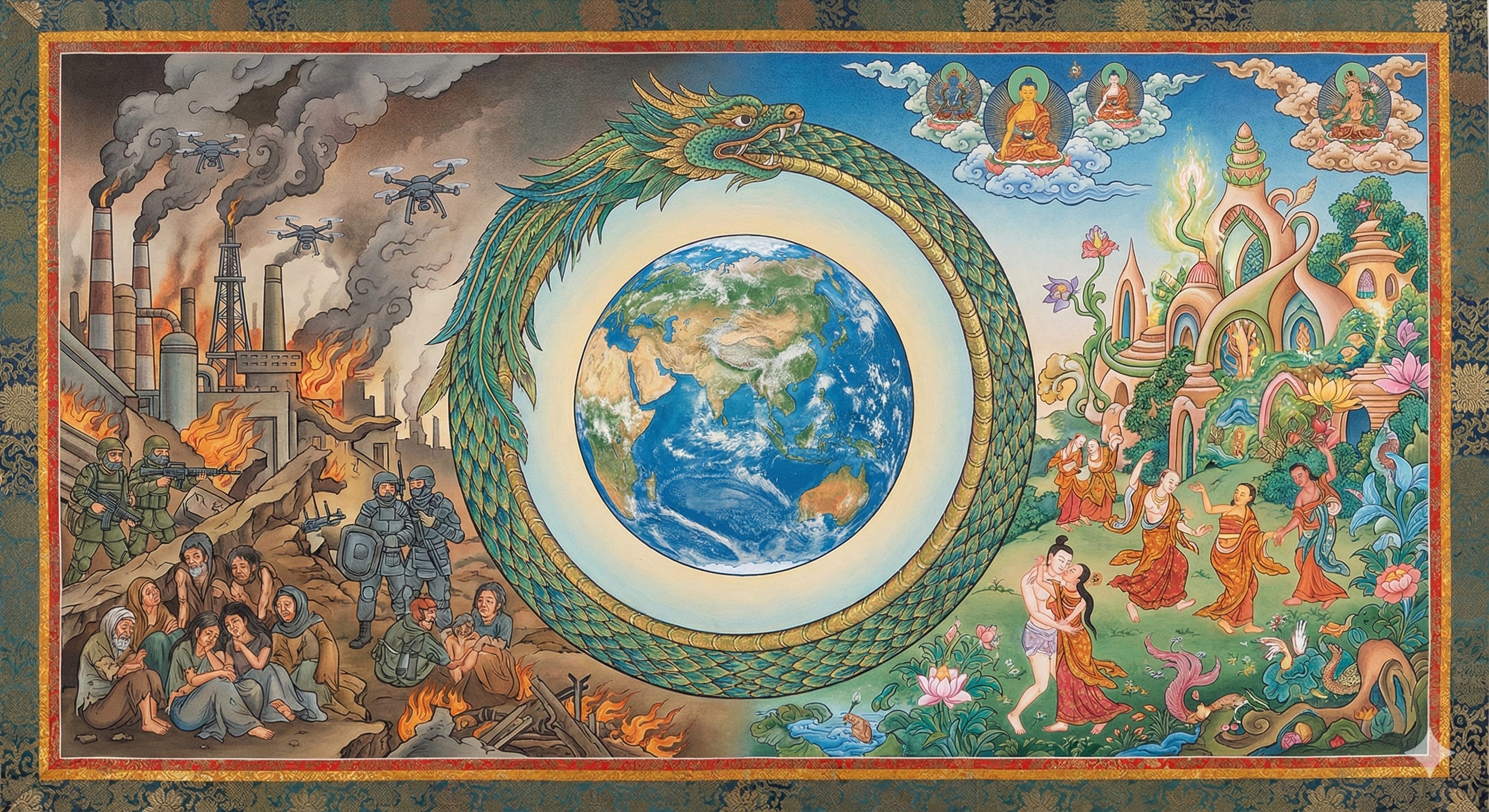
Trump is demolishing our institutions, our laws, and our norms at an incredible rate. He is wrecking the world order as he and his cronies seek to turn America into a techno-fascist dystopia and steal the country’s wealth for their own benefit. This destruction is harrowing, scary, to witness. It may lead to utter collapse, or a heartless Fascist dictatorship that, Pol Pot-style, brutally executes millions. I don’t want to sound overly optimistic, flippant, or naive about this terrible situation, but I do think it is possible there could be a hidden gift in this wreckage, if we somehow make it through to the other side.
The Trump regime has laid bare the venality, lawless arrogance, and insatiable greed of the oligarch class, which is a nonpartisan reality. The regime has exposed how our institutions and leaders are rotten, totally compromised and corrupted by corporate interests and the financial elite. Our systems and structures were already failing us. Our institutions were already hollowed out, incapable of addressing the convergent crises confronting us, including the big one that nobody is even talking about it right now, the ecological crisis.
I know it seems a long shot, but it is possible that this systemic cratering creates a necessary opening. If we can avert the threat of totalitarian techno-fascism, we could rebuild and redesign our society with greater wisdom, drawing on a depth of understanding of anthropology, psychology, sociology, world mythology, and so on. With our high-tech tools, including social networks and AI, we could resculpt our systems and rebuild new institutions, if we had a sensible plan of action, at hyperspeed.
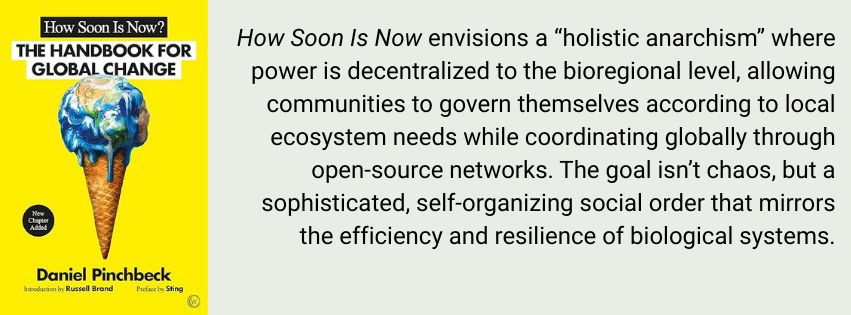
I spent ten years developing a model for exactly this kind of civilizational redesign. In 2016, I published How Soon Is Now?, where I offered a path forward. At that point, the book may have been ahead of its time. It didn’t get the kind of reception I hoped for, or build the kind of movement I wanted to see. However, perhaps the time for such a vision is coming closer.
The book operates from a premise that feels even more urgent now: the environmental, economic, and social crises of our time are not merely technical problems to be solved. They represent a “planetary initiation”—a collective rite of passage forcing humanity to evolve from an adolescent, parasitic relationship with the Earth into mature, symbiotic stewardship. This transition requires more than incremental reform. We need a systemic overhaul in how we live, trade, govern, and relate to one another and the cosmos. I proposed a synthesis of archaic indigenous wisdom and futuristic technology. I envisioned a society that is socially cohesive, politically participatory, economically regenerative, libidinally charged, technologically biomimetic, culturally liberated, and spiritually awakened.
I argue that our current civilization is driven by a subconscious death drive, manifest in a system of infinite growth rapidly consuming the biosphere. To break out of this, we must shift our foundational worldview from separation and dominance to interdependence and symbiosis. In natural systems, symbiosis eventually “out competes” dominance and aggression. Trees, for instance, lasted much longer than dinosaurs.
We need to redesign our society so people feel intrinsically happier, better supported, and more fulfilled. I believe this requires something like a universal basic income; however, it also means we need to address the root causes of loneliness and the crisis of meaning that have caused so many people to lose their minds. The isolation of the nuclear family and the alienation of modern urban life are aberrations in human history. I advocate for a return, over time, to community-based living, where resources, childcare, and labor are shared—reducing the ecological footprint of the individual while increasing emotional security.
One important idea for me is "the production of subjectivity," articulated by the political philosopher Antonio Negri. According to Negri, our interior lives—our desires, values, and worldviews—are not purely personal but are actively manufactured by the "immaterial production" of mass media and advertising. Currently, this machinery is largely calibrated to generate "false needs" and maintain a passive, consumerist populace; however, understanding this process reveals a hidden lever for rapid social transformation. Because our social tools and media networks are so effective at coordinating behavior and imprinting consciousness on a mass scale, they possess the latent potential to be repurposed. By seizing the means of producing subjectivity, we could intentionally disseminate a new global operating system based on empathy, cooperation, and ecological resilience, effectively "deprogramming" the collective mind from its suicidal trajectory and engineering a sudden, positive evolution in human behavior.
In How Soon Is Now, I critique the repression of Eros in modern Western society, arguing that the privatization of love and enforcement of strict monogamy lead to neurosis, stagnation, and social fragmentation. The sexual liberation of the 1960s and 1970s didn’t ultimately bring about an emancipation of society, and I agree with some of the criticisms that men benefitted more than women from this incomplete liberation. However, I still feel there is more work to be done in this direction, and a more complete and holistic liberation based in a deeper awareness remains possible, and preferable.
Ultimately, I envision a culture that destigmatizes sexuality and fosters a “liberated Eros,” where love can flow more freely within communities, strengthening the social fabric rather than threatening it. By healing the divide between masculine and feminine and moving toward a partnership model, society can overcome the patriarchal aggression that fuels war and exploitation.
This social transformation is linked to a radical reimagining of the political and economic landscape. While I critique neoliberal capitalism as a “suicide machine” programmed to convert the natural world into capital until nothing remains, I don’t judge capitalism or negate its achievements. I see it as a necessary transitional system that meshed the world into one global market and universal communications network—like a biological process of evolution. The concept of private property, specifically the hoarding of vast resources by a global elite, is obsolete software that must be overwritten. In its place, I propose a post-capitalist economy based on stewardship and “usufruct”—the right to use resources provided they are not damaged. The Earth’s resources would be treated as a commons, managed cooperatively for the benefit of all.
To facilitate this shift, I call for alternative currencies and value exchange systems that encourage circulation and cooperation rather than hoarding and competition. These include “negative interest” currencies (demurrage), which lose value over time, incentivizing immediate spending and investment in community. I support universal basic income so that people do not have to live in fear of survival. A UBI would help liberate human creativity, allowing people to contribute to the design revolution and the intense bioremediation we need to address our planetary emergency. As an aside, if AI takes away all of our “bullshit jobs,” then people could be retrained to restore wetlands, build rooftop gardens, support ocean aquaculture, and so on.
Politically, I envision moving away from the corrupted structures of representative democracy—now thoroughly captured by corporate interests—toward fluid, localized forms of direct democracy and proxy voting. I’m intrigued by “Liquid Democracy” and digital platforms allowing real-time consensus building. I envision a “holistic anarchism” where power is decentralized to the bioregional level, allowing communities to govern themselves according to local ecosystem needs while coordinating globally through open-source networks. The nation state continues to exist but becomes somewhat vestigial, a bit like European aristocracies after the revolutions of the 18th and 19th Centuries. The goal isn’t chaos, but a sophisticated, self-organizing social order that mirrors the efficiency and resilience of biological systems.
Technologically, I rejected the binary choice between Luddite regression and blind accelerationism. I call for a conscious direction of technological evolution. Our industrial infrastructure must be reinvented to mimic nature’s processes—biomimicry. This means transitioning to renewable energy, developing “cradle-to-cradle” manufacturing where waste becomes food for another system, and implementing regenerative agriculture to sequester carbon and restore topsoil.
The technosphere need not be nature’s enemy; it can be a nascent layer of Earth’s evolution that, properly aligned, we use to enhance biospheric resilience. Our digital connectivity now serves to distract and disorient us, while the corporations and military build surveillance systems to control us virtually. Instead, our social networks should assist in the formation of a “global brain” capable of sensing planetary distress and coordinating collective action.
I propose we won’t be able to make effective structural and social changes without a corresponding shift in our ideology and metaphysics. The secular materialism of the modern age is a dead end that has stripped the world of meaning and agency. To survive, we must recover the sacred dimension of existence—not through dogmatic religion, but by integrating scientific rationality with the experiential truths of mysticism and shamanism. For me, this means embracing “analytic idealism” as the most likely model. Analytic idealism proposes that consciousness is the fundamental level of reality, the ontological primary, instead of anything material. This allows us to understand the world’s divergent religions and spiritual traditions in a more holistic and integrated way.
The ecological crisis forces us to confront consciousness as a fundamental property of the universe. Through practices that alter and expand consciousness—meditation, yoga, the responsible use of entheogens like ayahuasca and LSD—humanity can break free from the “possession trance” of consumerism. Once we breakthrough to realize our interconnectedness with all life, we are more likely to feel grateful and secure, instead of frustrated and fearful.
This spiritual awakening catalyzes what I describe as a planetary super-organism. Just as single cells once cooperated to form multicellular organisms, human beings are now pressured by evolutionary forces to merge into a higher order of collective being—characterized by empathy, resonance, and shared intention to heal the Earth.
To quote myself: “Humanity, as a whole, constitutes a planetary super-organism, one unified being, in an ongoing, symbiotic relationship with the ecology of the Earth as a whole system.” This realization transforms the crisis from tragedy to opportunity—a purging fire, burning away obsolete structures to make way for our next expression.
We are effectively out of time to make incremental change. The urgency of the climate emergency dictates a “global reboot”—a rapid, voluntary transformation of values and behaviors, a cultural shift from the pursuit of “having” to the joy of “being,” where status derives not from material accumulation but from service to the collective and the cultivation of wisdom. Since writing the book, I do realize more dimensions of the problem that are hard to address. For instance, George Lakoff, in Don’t Think of an Elephant, writes about how ideologies are like neurological imprints and it takes time to change people’s frames.
Ultimately, How Soon Is Now? offers a blueprint for a society that creates abundance through sharing rather than extraction—a world where technology serves ecology, economy serves community, and politics serves the liberation of the human spirit. The path forward is to embrace the crisis as a prompt for our collective maturation. The destructive systems we’ve built are projections of our own unhealed psyches. We need to heal ourselves and our relationships to heal the world, but, also, healing is a never-ending process, and healing becomes a bit of a fixation for many people who should reach a point where they feel “healed enough” to shift from self care to service for the collective.
I don’t see this as a grim duty but as a heroic journey: Our opportunity to participate in the conscious evolution of the cosmos. “We have unleashed planetary catastrophe through our actions as a species,” I wrote. “We have induced an initiatory crisis for humanity as a whole. I think that on a subconscious level we have willed this into being.”
The redesign that our society requires is very deep. But it is within reach if enough of us can overcome our conditioning and embrace this time as an initiatory challenge. We must step out of the legacy of domination and control, into a future of communion and surrender. The social metamorphosis would dissolve boundaries between self and other, culture and nature, realizing a unity that renders old mechanisms of manipulation and exploitation obsolete. As Tamera founder Dieter Duhm writes: “We need a revolution whose victory will create no losers because it will achieve a state that benefits all.”
I believe you describe, in technical terms, what Teilhard du Chardin called the “noosphere,” an idea that first intrigued me in those ‘70s of rapid change. Today more and more people seem highly aware of a growing spiritual awakening, a surge toward personal awareness of what Jung called universal consciousness, and an evolution of religiosity with its duality and separation into what some call Interspirituality. And Quantum physics is bridging that age-old chasm between science and religion. AI scares a 91 year-old woman like me, I don’t understand more than one-fourth of the technological language, and I doubt I will see the results you describe in this lifetime, but I understand hope. I’ll be back—if it’s possible—to see if your dreams (and mine) of a kinder, saner, more loving world come true.
I really need to read the book! It’s on my (audio) end table! There is much in here to celebrate and energize. This is the kind of portrait that unsticks our imaginations, and I think we need much more of it. We also need to keep celebrating where things are working, even at their most specific. My husband, fearing for my psyche (ha-not really but kind of) sent this mother jones article this am:
“f we were living under fascism right now, the words I’m writing would be a death sentence. Mother Jones would be outlawed, as would the New York Times. There would be no Democratic Party, no independent judiciary, no No Kings marches. If my grandparents had so much as held a sign at an intersection, they would never have made it home.
The seeds of fascism and authoritarianism have always been present in America, and they are sprouting. But we also still have rights that people in 1930s Germany (or contemporary Russia or China) would have died for. It’s time to use them.”
This is where I think we have the twin purposes of supporting and holding up what works to prevent further descent/control WHILE building the new. People need to become psychologically unstuck from paralysis and from the only model we knew. As you write, it can be dramatically improved upon. It was largely already captured.
This requires effort and prioritizing amid the zillions of other demands and distractions. I think most people reach that point when it hits them personally. As long as they can go out to dinner and go to the gym, things seem ignorable. I get it. Like you, I’ve long seen the writing on the wall, the hokes in society. But even for me, with a lot of really intense things going on at personally, I think the layers of adaptability have been really tested. And I’m seeing who I really am, what I’m really about, and what I truly think about God and the meaning of life in a non-abstract way. Sometimes things and people have to be stripped down to the studs in order to rebuild. I think we probably all get there at some point in some lifetime, anc I agree that these mounting crises are in fact really starting to hit people. Of course, there are many people who are not lunatics who think that much of what is happening is beneficial. Did you read this article about Venezuela?
https://renegaderesources.pro/p/the-venezuelan-oil-narative-is-pure?utm_medium=ios