

When Reason Fails
The collapse of liberalism in a post-secular world

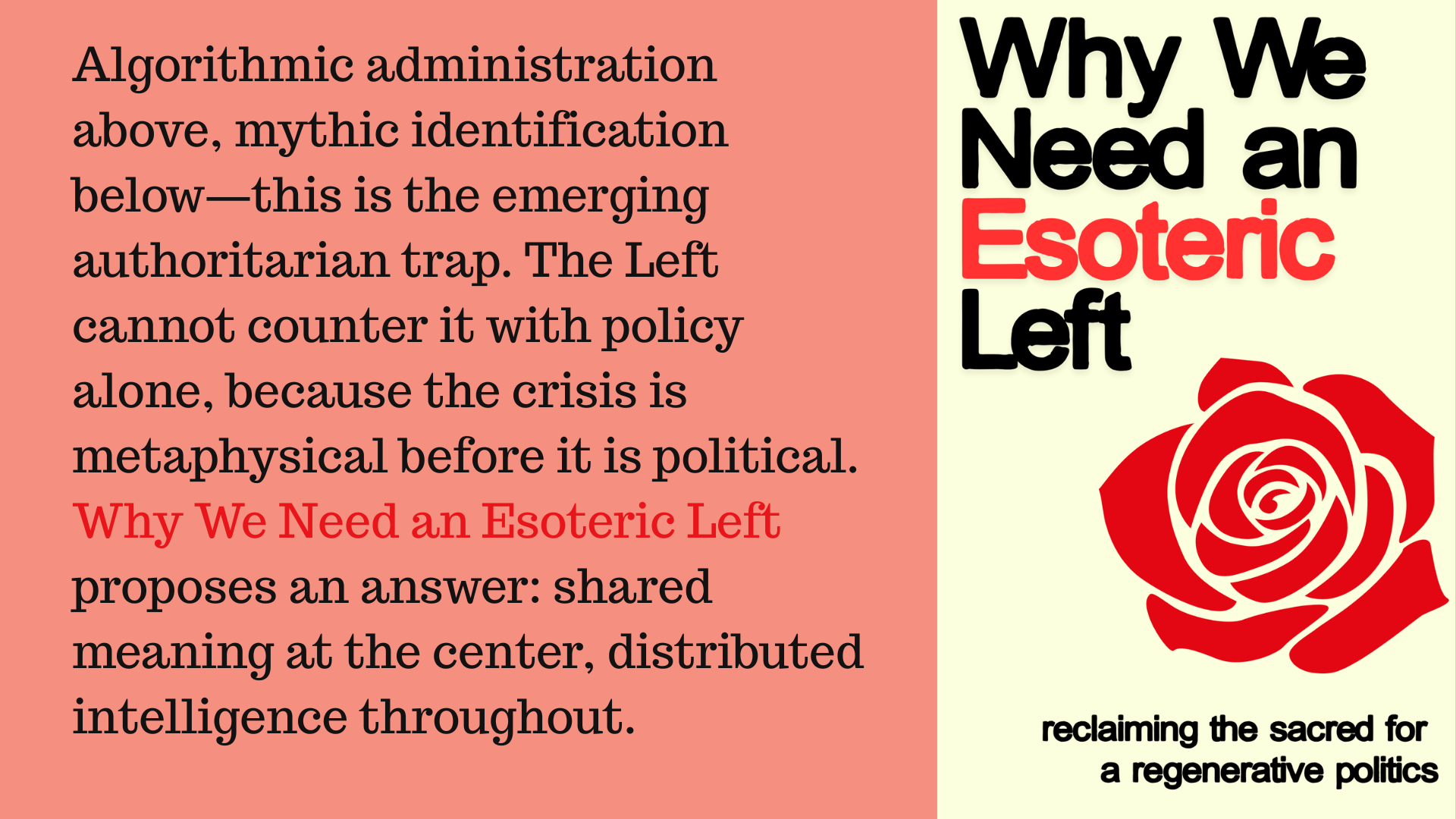
This piece marks the opening of Chapter Five of Why We Need an Esoteric Left, the book I am serializing here as I write it.
For readers joining mid-stream, the preceding chapters put forth a diagnosis. The American Right took political and cultural power because it offers a narrative of meaning and purpose. Cruel and distorted though it is, it remains a story: men are warriors in an Apocalyptic and Manichean conflict, women are guardians of civilizational continuity and the hearth, and wealth is the visible sign of divine favor. The Left counters with policy white papers, legal briefs, and structural critiques, with no metaphysical force beneath them.
This asymmetry is not a failure of branding or political messaging. Two centuries ago, the Left aligned itself with the scientific revolution, with materialism and the “demystification” of any transcendent hopes. In adopting a strict materialist posture—only acknowledging empirical facts, treating consciousness as an accidental biological byproduct, and dismissing religion as an opiate and the supernatural as superstition—the Left cut it itself off from the language of myth. Meanwhile, the Right has reorganized itself around a new ordering principle: algorithmic administration above, mythic identification below.
Chapter Five looks at the growing awareness, across many fields of inquiry, that modern civilization cannot survive without some form of mythic or transcendent ethos that dignifies human life and human suffering. We will be look at four disparate thinkers: German philosopher Jürgen Habermas, the American Catholic reactionary Patrick Deneen, the Mexican techno-optimist Macario Schettino, and the British philosopher Simon Critchley.
Despite their ideological differences, all four arrive at a similar conclusion: a purely secular, procedural order cannot generate the solidarity required to maintain post-industrial civilization. What divides them is the proposed remedy. Deneen advocates for a post-liberal aristocratic elite to impose a traditional order from above; Schettino expects technological automation to synthesize a new socio-economic paradigm; Critchley proposes a “faith of the faithless,” asking us to embrace a supreme fiction while fully aware of its fictional nature.
This installment focuses on the first thinker: Habermas spent half a century constructing a rigorous defense of political legitimacy in modern states. He then changed his mind, concluding that secular reason cannot supply the binding force we require, and a new synthesis of religion and reason is necessary.
This jarring period feels less like a routine political realignment and more like a structural collapse. Liberalism—the centuries-old framework built on individual liberties, human rights, rule of law, free markets, and consent of the governed—is giving way. With it goes the broader Enlightenment project, which anchored human progress in empirical reason, open inquiry, and the scientific method. For two centuries, these two forces drove the expansion of representative democracy across the globe.
That expansion has halted. More than three decades ago, Francis Fukuyama famously predicted the “end of history,” envisioning a globalized world bound together by liberal institutions. Today, that vision lies shattered. Democracies retreat while autocracies multiply. Where elections survive, states often reduce them to ritualized theater, building “competitive authoritarian” regimes that hollow out genuine participation from within.
The unraveling of the liberal world order is a stunning turnaround. By the mid-1990s, Freedom House reported that roughly three-fifths of the world’s sovereign states had embraced democratic governance, and V-Dem Institute metrics show that over half of the global population lived under democratic rule by the turn of the century. Today, those figures have inverted. According to the V-Dem Institute’s 2026 Democracy Report, autocracies now outnumber democracies—92 to 87—for the first time in more than two decades. Only 7% of the world’s population now lives in a liberal democracy—the lowest proportion in half a century—while 74% live under some form of autocratic rule.
Four thinkers with wildly divergent commitments illuminate this moment: a German liberal rooted in the Frankfurt School, an American Catholic reactionary, a Mexican techno-optimist, and a British atheist of the Left. Despite their ideological battles, they arrive at a shared diagnosis. A purely secular order cannot generate solidarity from its own resources. It lacks the engine to move citizens to shared sacrifice. To survive, society must recover, adapt, or invent a transcendent framework to bind its people together. The battle today centers on who builds this framework, and to what end.
This emergency did not arrive unannounced. The German philosopher Jürgen Habermas mapped its fault lines decades ago. In Legitimation Crisis (1973), he observed that modern states must constantly intervene in the market to smooth over capital’s inherent instability. This intervention exposed a central myth of classical liberalism: that markets exist as autonomous, natural realms of equal exchange. When the state picks corporate winners, adjusts interest rates, and directs public funds, economic outcomes cease to look like natural phenomena. Poverty, inflation, and structural inequality reveal themselves as political choices. The illusion snapped.
As the state intervened to shore up market outcomes, it inevitably disrupted cultural traditions and social norms. In his later major work, The Theory of Communicative Action (1981), Habermas formalized this dynamic as the conflict between the “system”—the administrative state and the market economy—and the “lifeworld.” The lifeworld represents the background horizon of shared meanings, organic relationships, traditions, and intuitive habits through which human beings actually live, communicate, and understand one another. State interventions continuously invade this sphere: public education sculpts the beliefs of the next generation, while administrative welfare frameworks shape family structures and child-rearing practices.
State planning creates its own trap. By steering the economy, the state invites public blame whenever the system falters. Governments must guarantee capital growth to service debt while appeasing a discontented workforce. The state bears accountability for every economic downturn, yet lacks the democratic consensus required to stabilize society.
To resolve this deadlock, Habermas called for a radical expansion of “communicative rationality”—a public sphere where citizens form binding consensus through open, uncoerced debate. “There is no administrative production of meaning,” he wrote. No central ministry, financial market, or media campaign can manufacture the moral legitimacy required to hold a society together. Legitimacy demands what he called “the unforced force of the better argument.” Modern politics faces a stark binary: expand democratic participation, or abandon it to technocratic control.
Habermas’s early work treated religious faith as a developmental stage that rational societies would naturally outgrow. In The Theory of Communicative Action, he argued that secular consensus would inherit the unifying role once played by sacred ritual. “The authority of the holy is gradually replaced by the authority of an achieved consensus,” he declared. Religion, he believed, would recede into private life, leaving public governance to pure reason.
