

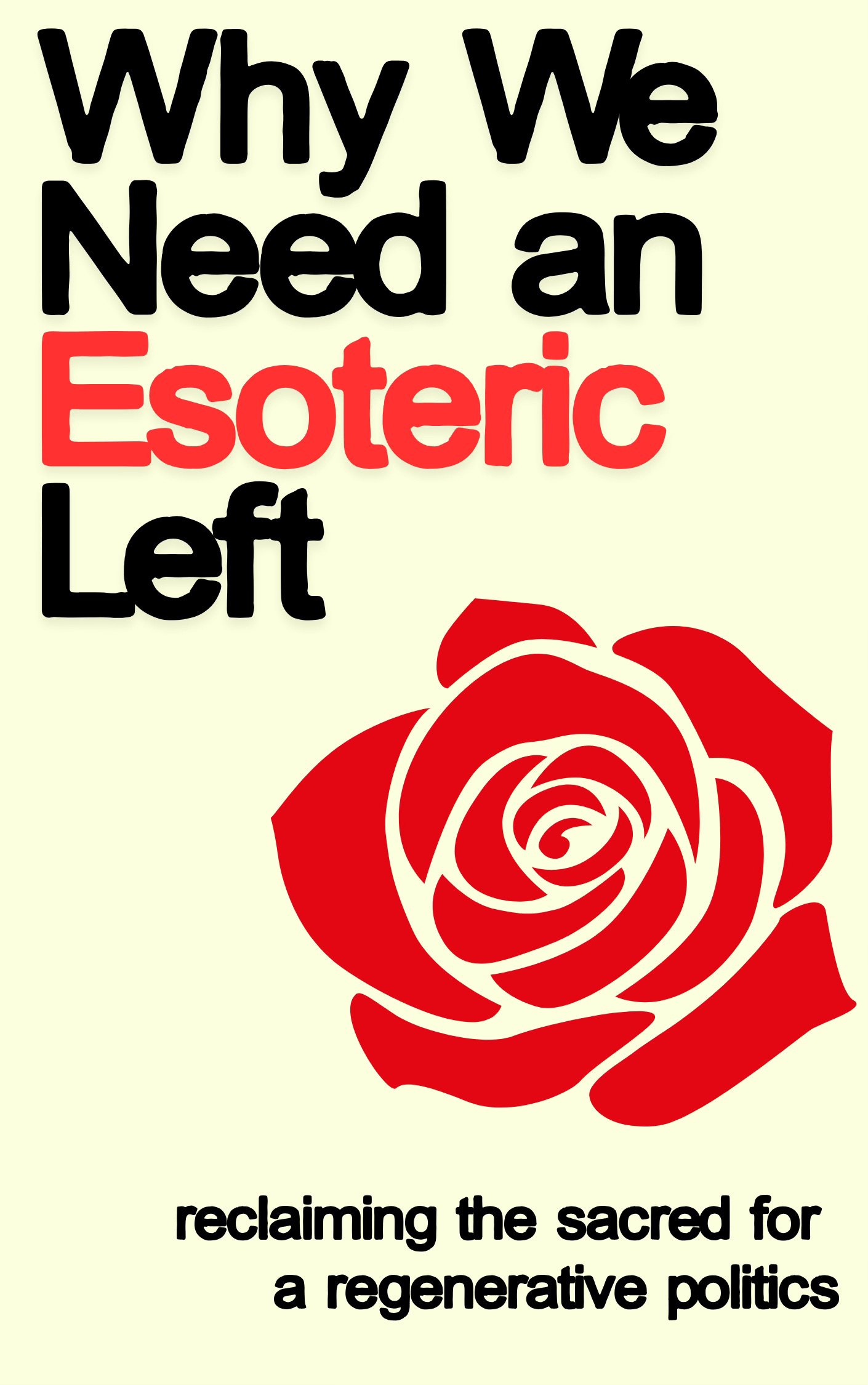
Why We Need an Esoteric Left
Reclaiming the sacred for a regenerative politics

Hi folks,
Over the next weeks, I am inviting you to join me in an experiment. I am working on a new book, hopefully a relatively concise tome, Why We Need an Esoteric Left. You see my first attempt at the cover, above (please let me know if you like it in the comments). I thought I would serialize the book and publish it here, as I write it. I would love your input, honest criticism, and any ideas in the comments. I may incorporate them directly, with a “thank you” in the acknowledgments. The manuscript will go through a few levels of revision before I release it, so this feels a bit raw as a process. But I thought that could make it fun.
Below is the first part of the introduction. But before I get to that, I want to put in a few other short plugs for things I am working on now that you might enjoy. I have been expanding my YouTube channel, working with a small team. We have reached a threshold of respectability with 35,000 subscribers. I am totally fascinated, right now with the creative possibilities of YouTube and the video essay as a format. At some point, I will publish a list of some of my favorite channels, along with some thoughts on the future of YouTube as a medium. We just launched a new series of “faceless” Youtube videos, with Why Has the World Gone Insane? Part One and Part Two.
Please check them out! Some may object to the use of an AI voice for these. I find it effective and quite soothing, but I am curious to hear what people think. The pushback against using AI is so strong that we may stick to human voices from now on.
I have been creating a series of short videos to promote the recently published anthology, Secret Histories and Spiritual Revolutions, including a reenactment of the life of a Medieval nun who wrote a heretical masterpiece in the 13th Century, a faithful recreation of The Apocryphon of John, and a silly short advertisement. Please check them out if you can.
As I mentioned a few days ago, I intend to produce a Youtube Show and hopefully a feature film based on first book, Breaking Open the Head, which celebrates its 25th anniversary next year. Since this requires more resources than I possess, I have set up a GoFundMe for the project. Please contribute if you want to support the initiative.
Thank you! - D
Introduction: Metaphysics and Politics
I have been thinking about the Left, and its failures, for most of my life. My mother, Joyce Johnson, is a writer and radical book editor who published many leftist books in the 1960s and 70s, including Abbie Hoffman’s Revolution for the Hell of It, Julius Lester’s Look Out, Whitey! Black Power’s Gon’ Get Your Mama!, and Ron Kovic’s Born on the Fourth of July. I grew up with some of these figures, including the Beat poet and ardent anti-war activist Allen Ginsberg. My mother was part of the “New Left” in the early seventies. I remember going with her to meetings at the Free Association on Bleecker Street where her friends started an educational center where admission cost nothing, open to all. For a time, she dated a celebrated radical labor organizer who turned out to be a bit of a Lothario. Another friend of hers, Anthony Russo, helped photocopy and release the Pentagon Papers — an act of resistance that turned public opinion against the Vietnam War.

I suppose I should define what, exactly, I mean by the Left. The political Right, like the political Left, comprises a spectrum. President Donald Trump attacks mainstream and corporate establishment Democrats in Congress as “radical Left lunatics,” because they oppose elements of his agenda. Personally, I wouldn’t even call many of the Democrats that Trump demonizes “leftists.” Many support a military and corporate agenda that violates leftist principles. Even when the Democrats won all three branches of the government, they couldn’t tax the wealthy effectively, address ecological collapse, or institute universal health care. The Democrats’ multi-decade futility has fed working-class rage, paving the way for our country’s accelerated decay.
What I consider “Left” is, as a starting point, what we find in many European countries which have progressive taxation as well as free public education and free health care. That seems like the beginning of a civilized society, something we never had in the U.S. and which is now far away. However, personally, as we will explore later, I am partial to more radical ideas, particularly now, when our system is in free fall.
Part of the problem with the Left is that it is often better at identifying what it is against than what it wants. The Left, broadly, fights against institutionalized inequality, against excessive corporate power and the privatization of basic services, and seeks to address, to some extent, the ecological breakdown caused by industrial civilization. I was involved, peripherally, with two recent leftist movements, Occupy Wall Street and Extinction Rebellion. Both were energetic, but they were essentially negative and reactive, as the names indicate. They failed to accomplish meaningful social change.
My feeling is that one reason recent leftist movements fall short is because they don’t point people toward anything astonishing, wonderful, or fabulous as a future ideal. Most people don’t get inspired by incremental policy shifts or “sustainability.” People need a vision of a future that excites their imagination, that awakens their yearning to experience a new world or embark on a new voyage of discovery.
The Irish dandy Oscar Wilde realized all of this back in 1891: “A map of the world that does not include Utopia is not worth even glancing at, for it leaves out the one country at which Humanity is always landing. And when Humanity lands there, it looks out, and, seeing a better country, sets sail. Progress is the realization of utopias.” In fact, global capitalism and mass consumerism realized a once impossible and utopian promise: that people everywhere might access goods and exotic foods from across the Earth — something once totally unimaginable — and travel the world for themselves. This was an extraordinary, hyperstitional accomplishment of the modern world: A wild fiction made real. While the Right offers visions of a future life on Mars, salvation via the Rapture, or even the return to a traditional society where men and women worship God and “know their place,” the Left offers no defined ideal of the amazing world or future utopia we plan to build together.
Leftist movements like Extinction Rebellion and 350.org tell people that the best they can hope for is a future of severely reduced opportunity, with no silver lining. We may be able to slow the rate of destruction slightly by scaling back our lives, reducing our ecological footprint, and forcing everyone to live with less. That is highly demotivating. On a mass scale, it can’t work. A movement built on refusal and reduction cannot ask people to relinquish what they have or what they might attain, without giving them a new ideal or promise for a different kind of future.
The Left once possessed charismatic leaders who found ways to motivate people to act in great numbers, with extraordinary courage, to fulfill a collective vision of what our world should and could be. Almost universally, the most powerful movements for radical change start from a religious or spiritual basis. This included the Civil Rights movement led by Martin Luther King in the US and Gandhi’s satyagraha movement in India.
King claimed he had been to the mountaintop and seen the promised land — the realization of the Beloved Community. Gandhi promoted a vision of a liberated India as a spiritual ideal, and convinced his people to suffer for it. “The religion of nonviolence is not meant merely for the rishis and saints,” Gandhi wrote. “It is meant for the common people as well… The dignity of man requires obedience to a higher law — to the strength of the spirit.” When Gandhi undertook to organize India against the British Empire — the largest military force in the world — using principles of nonviolence, or satyagraha, it must have seemed, at first, a ludicrous and impossible task.
Things can change. At propitious moments, we can change them, overcoming the odds and defying the cynics. But to do so, we need a vision. Where is our vision now?
Fascists, authoritarians, are constantly terrified that a stray spark of truth might suddenly catch fire to unleash a massive conflagration — as well they should be. But we can’t have that collective eruption without a shared understanding of our mission and our goal. There are at least two missing parts of the project that the Left, so far, refuses to supply. A successful radical movement needs a “what” — a model for how the new society will be organized, on what priniciples and toward what goals. It also needs a “why” — a tangible vision of a better tomorrow rooted in an aspirational vision of human nature, promising, in some sense, a future “utopia.” The movement must inspire people to work together, to struggle and even sacrifice themselves because they see something greater ahead.
Gandhi, for instance, told his followers that the goal was economic equality, peace, and independence: “Working for economic equality means abolishing the eternal conflict between capital and labour. It means the leveling down of the few rich in whose hands is concentrated the bulk of the nation’s wealth on the one hand, and a leveling up of the semi-starved naked millions on the other.” King promised a path to reconciliation, redemption, and agapé: “The end is reconciliation; the end is redemption; the end is the creation of the Beloved Community. It is this type of spirit and this type of love that can transform opponents into friends. It is this type of understanding goodwill that will transform the deep gloom of the old age into the exuberant gladness of the new age.”
At this point in the U.S., most people, including the vast majority of younger people, seem eerily dissociated and checked out. The “deep gloom of the old age” has never felt gloomier. The authoritarian Trump regime, backed by fossil fuel and “technofeudal” oligarchs, has effectively created a murky climate of fear, chaos, and futility. I find it amazing and depressing that the incredible levels of corruption we see with Trump, his family and his minions, plus the dismantling of Constitutional protections and the viciously cruel treatment of marginalized people, has not produced a more powerful counter-movement as of yet. There are many reasons for this. My sense is that the problem is not just the fear of oppression — which is legitimate and real — but also the sense that we lack a meaningful alternative outside of what the critic Mark Fisher called “capitalist realism.” Fisher noted that it is easier to imagine the end of the world than the end of capitalism — although some argue we aren’t even in traditional capitalism anymore, but transitioning into something much worse.
I believe that the problem for the Left is not just political, but metaphysical. If we are going to awaken the people to risk themselves and push back en masse against the authoritarian and fascist menace which poses an existential threat to all of us as well as the future of the planet, we need something much more powerful than better ideas around taxation and regulation. A new “new Left” needs to tap into the numinous, to reach into the deep wellsprings of illumination and revelation which have traditionally impelled humanity forward on its evolutionary journey. We need a replenished sense of meaning and possibility, anchoring a deep belief that impels us beyond the known and familiar: We need a new vision of what we can be, how we can live, and what we can create together. We need a bit of magic.
The Right, in its crude and degraded way, completely understands this. The Right has seized on and captured the language of myth, religion, the occult, and the sacred. They have understood that people yearn for deeper meaning, cosmic significance, and the possibility of redemption — that ordinary political debate doesn’t satisfy the soul’s real hunger. This is something the Left, for the most part, refuses to acknowledge.
