


I wanted to share my first adventure in AI-based filmmaking, along with some reflections on it. First of all, this piece is not entirely finished, so please pardon the rough spots (transitions, etc). Although, to be honest, as a fan of Brecht, Godard and so on, I kind of like the rough spots. I look forward to hearing your thoughts and comments (be gentle please).
I made this in six long days and nights for our workshop, Mastering the Alchemy of AI Storytelling. I wanted to create something to learn about the tools for myself. At this juncture, making AI videos is a fascinating puzzle: It can make previously impossible things incredibly easy to do (special effects that would have cost a fortune), while seemingly simple things can be almost impossible. Even at this stage, I would say it offers a tremendous opportunity for individual creators — an extraordinary playground for the creative mind. By the way, you can still sign up and join us for the next month, at www.liminal.news . You can catch up on the past recordings. We have Jason Silva joining us this Sunday. He has been making some entertaining AI work such as this one.

I’ve had to take a moment’s pause from writing about the situation in the U.S., which brings fresh horrors each day. I actually think that Stiegler’s ideas give us the proper context to understand what is otherwise incomprehensible: The U.S. rapaciously tearing itself apart and senselessly destroying itself, based on the dictates of a malignant narcissist.
For my film, why did I choose to focus on Bernard Stiegler, a French philosopher who passed away in 2020? It sort of just happened—it felt like an inner compulsion. I am finding myself deeply compelled by Stiegler’s ideas, which resonate with many of my own, as I expressed in books such as How Soon Is Now and 2012. I don’t connect to the regressive / Luddite thesis of someone like Paul Kingsnorth, and I utterly reject the transhumanist / Singularity philosophy of Ray Kurzweil, and so on. My little film is both an appreciation of Stiegler’s rhetoric, and an effort to model what he is talking about, as I understand it.
Stiegler wrote about technologies as the constitutive elements of human time and consciousness. Our capacity to develop and use new technologies is what makes us distinctly human. However, we have reached a point where our greatest talent as a species also poses our greatest threat.
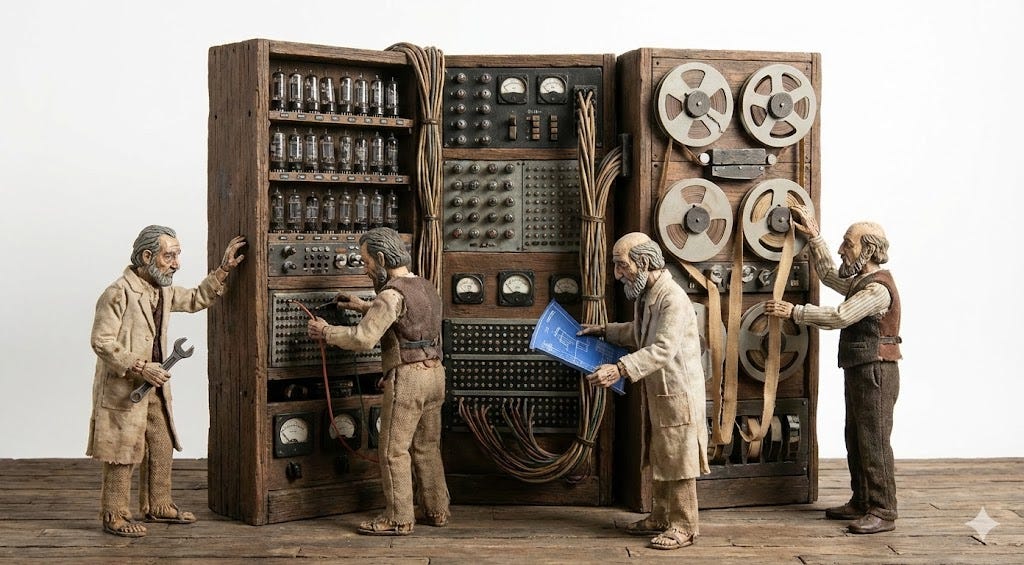
Stiegler served time in prison for armed robbery, where he developed his interest in philosophy. Later, he directed the Institut de recherche et d’innovation at the Centre Pompidou and founded the activist group Ars Industrialis. He dedicated his life to diagnosing the “pharmalogical crisis” of our post-industrial civilization: Due to the acceleration of innovation and the “automization” of the mind, we have lost the ability to imagine our own future. His work is dense and at times verges on inscrutable, yet his diagnosis of our condition is, I find, extremely helpful and perhaps even necessary for understanding our current situation: Both the disorientation we face today, and the rise of Trumpism. David Golumbia, a scholar of digital culture, wrote: “Bernard Stiegler is the most important French theorist to come after Derrida, and one of the most important thinkers anywhere about the effects of digital technology.”
Stiegler calls our current situation a “pharmacological crisis:” We have reached a critical tipping point where the toxic effects of our technologies have overwhelmed our collective ability to utilize them as remedies. In Stiegler’s reading, following Derrida and Plato, every technical object is a pharmakon: Simultaneously a poison and a cure, a power of destruction and a power of construction. Writing, for instance, is a remedy for memory because it records information, but it is also a poison because it leads to loss of memory and forgetting.
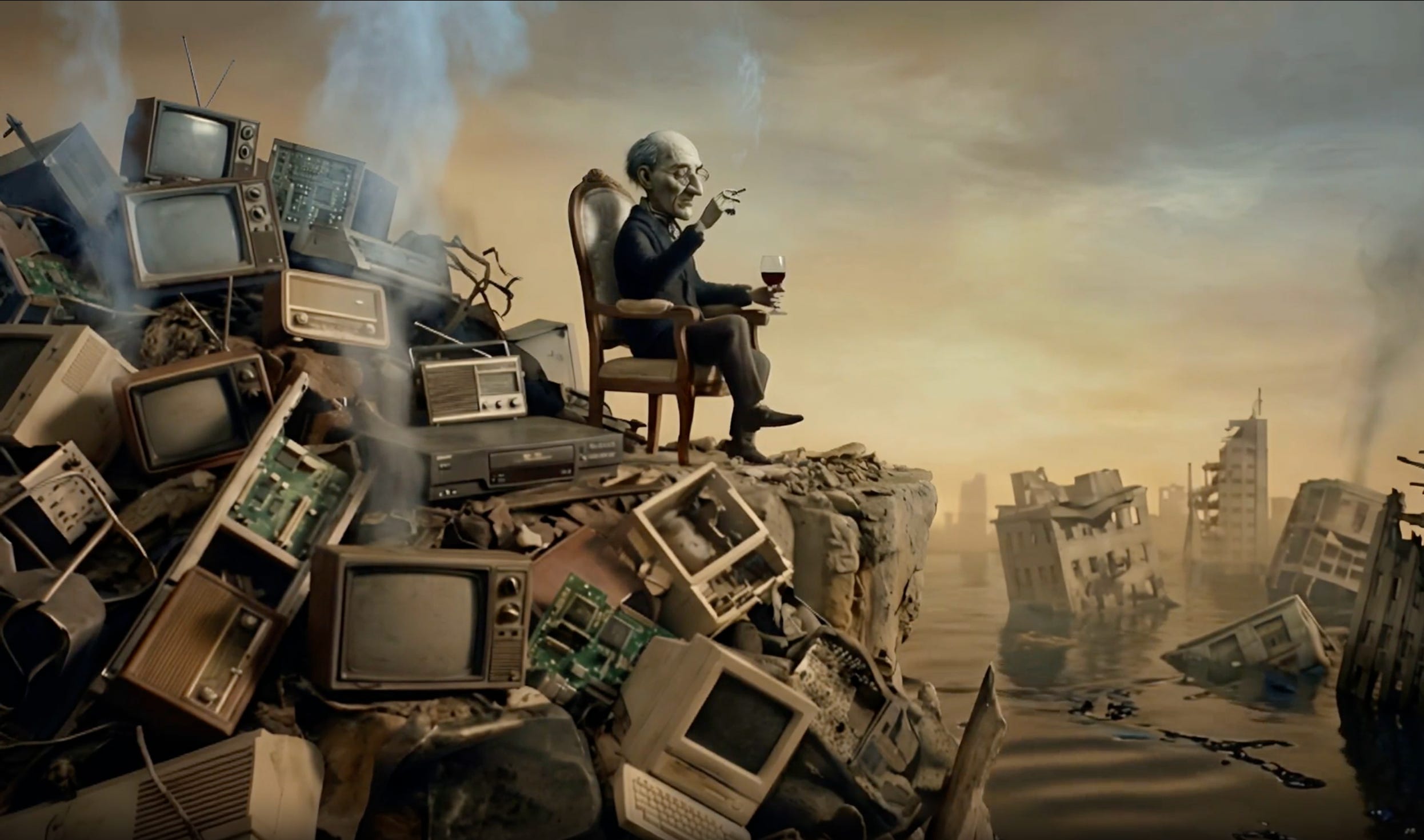
Every major new technology—particularly communication technologies because they structure consciousness and identity in a deeply phenomenological way—requires time and effort to assimilate. The printing press, for instance, led to the English Civil War and the Reformation, then the bourgeois revolutions of the 18th Centuries and the rise of the modern liberal nation-state. It took several centuries for humanity to develop the laws, codes, and social institutions to assimilate this technological rupture.
Today we are in a crisis because the “poison” aspect of digital technology, with its accelerated pace of innovation, has overwhelmed the capacity of our social systems to mesh it into humanized structures. Instead, the digital domain has become dominant and uncontrolled. We are currently suffering from the toxicity of digital networks—manifested in the destruction of social bonds, the erosion of attention, and a generalized addiction to stimuli—without yet having established the necessary therapeutics. We lack the social rules, legal frameworks, and educational practices required to turn these technologies back into a cure, leaving us in a state of rampant toxicity.
The root of this pharmacological imbalance lies in the sheer speed of what Stiegler terms “disruption.” The evolution of our technical systems has radically outstripped the speed at which our social systems—our laws, culture, and education—can adapt. Historically, civilization advanced through a rhythm Stiegler describes as a “double epokhal redoubling.” In the first beat of this rhythm, a technical shock disrupts the existing order; in the second beat, society reorganizes itself to adopt the technology, creating a new stable epoch. This second beat allows for the integration of the new technical reality into a coherent way of life. In the current crisis, however, this second beat never arrives. As a result, we are seeing a regression into primitive modes of expression and literal barbarism.
The digital system—and now AI—evolves at the speed of light, constantly introducing new shocks before the previous ones can be absorbed. This acceleration creates a short-circuit where the technical system destroys social systems instead of being integrated by them. The result is a permanent state of “disadjustment,” leaving us in an “absence of epoch” where we are unable to project a coherent future or maintain the stability required for social life. Stiegler writes: “The age of disruption is the epoch of the absence of epoch, announced and foreshadowed not just by Adorno and Horkheimer as the ‘new kind of barbarism’, but by Heidegger as the ‘end of philosophy’... [and] by Nietzsche as nihilism.”
This disruption produces a condition Stiegler identifies as generalized “proletarianization”, defined not merely by economic poverty but by the liquidation of human knowledge and artisanship. Just as the nineteenth-century industrial machine replaced the worker’s manual skill, or savoir-faire, the digital pharmacological crisis automates our cognitive faculties. We are experiencing a massive loss of knowledge: the knowledge of how to live (savoir-vivre), how to do, and even how to self-reflect and theorize.
We rely on devices to remember, to navigate, and to calculate, allowing our own faculties to atrophy. This leads to a state of “systemic stupidity” or “functional stupidity,” where individuals and organizations blindly serve automated systems they no longer understand. Stiegler links this directly to a rise in madness and “ill-being” (mal-être), citing the despair of younger generations who feel they have no future because the very capacity to envision a future—to project oneself into time—has been automated by algorithms that anticipate our desires before we even form them.


